Showing posts with label Technology. Show all posts

Wednesday, October 15, 2008

How I Had 15 Minutes of Internet Fame (Without Really Trying) [IFTF]

Institute for the Future, October 15, 2008 [Link]

In 1968, Andy Warhol declared, "In the future, everyone will be world famous for 15 minutes." Maybe everyone being famous for 15 minutes is still part of a future we haven't achieved yet, but we're getting closer to something like it thanks largely to the Internet.

In 1968, Andy Warhol declared, "In the future, everyone will be world famous for 15 minutes." Maybe everyone being famous for 15 minutes is still part of a future we haven't achieved yet, but we're getting closer to something like it thanks largely to the Internet. We've seen fame coming to a variety of unlikely corners of the net, from a book deal for the guy who writes about stuff white people like to a MySpace celebrity getting her own dating reality show on VH1. But for many of the things that become "Internet famous," the creators behind the phenomenon remain out of the spotlight while their blogs get all the fame. It's not about lack of recognition; it's about a blog or a website becoming viral and achieving a kind of fame that transcends the people who made it.

Last week, in the wake of one of the worst few days for Wall Street ever, a friend Chris made his Facebook status message read something about it being a bad year for Wall Street but a banner year for pictures of sad guys on trading floors. I pinged him and within 15 minutes of my IM he'd set up a blog for us on Tumblr: http://sadguysontradingfloors.tumblr.com. We immediately started to curate and caption photos of traders accompanying stories about the stock market's decline. There were lots of them. The inclusion of a sad-looking trader with an article about the end of the financial world as we know it was an instant Internet meme.

I sent the Sad Guys on Trading Floors link to my IFTF colleague, friend, and blogger extraordinaire David Pescovitz. David posted our blog to his, BoingBoing, which is one of the most widely read blogs on the web. From there, it took off like a highly contagious virus. Some of the blogs mentioned Chris and I by name, but once we started to get into the bigger publications' blogs like New York Times: Economix and Wall Street Journal: The Wallet, the bloggers talked about the site and its content but never about us. But the blog was linked on social sites like MetaFilter (who railed on the lameness of our comments, sorry MeFi!); on magazine blogs like Andrew Sullivan's Daily Dish on TheAtlantic.com; Twittered by what seem to be a lot of people (and they're still Twittering us); and mentioned on CNBC.

On the first full day our blog was up on Tumblr, we had 259,390 page views. In Internet numbers, that's huge.

Chris and I were, and quite frankly still are, dumbfounded. All we did was agree on a noticeable phenomenon that we thought was funny (photos of distressed-looking traders accompanying stock market articles), open an account on Tumblr (Chris did that part), scour the web for pictures of sad traders (not hard to find; news site slideshows were a godsend), save the pics to our desktops, upload, write some captions that we at least found mildly amusing, and post. Our friends know we were behind it, but to most people, "we" are just some nameless people behind monitors who compiled a blog of pictures and captions. The blog kind of speaks for itself and became an entity unto itself. A few people took the time to find our email addresses and send us some "fan mail" and people on Tumblr reposted us. Some really good friends actually IMed me the link without knowing that I was a co-blogger until I told them.

On other sites some comments praised us, some made fun of our captions, and some comments pointed out that it was unfair to "blame the traders," since they were only at the behest of the big guys on top of Corruption Mountain. But that's not even what we were doing. We just thought it was funny that every single news article about the stock market was accompanied by a picture of a sad trader making a sad face, whether the expression was one of genuine dismay snapped during a time of actual crisis or had nothing to do with the declining stock market.

So does this count as my 15 minutes of fame? Who knows. A blog a friend and I made on a whim certainly got its 15 minutes of fame, but I'm not sure he and I personally did. But maybe this is what Warhol meant by 15 minutes of fame, that one day ideas and creations would take off—but only the people behind the ideas and their friends really know or care about who's behind the creation or creations. It's as if Warhol forecasted Internet fame before the Internet existed.

Somebody made a mashup with the images!


— Jess Hemerly, October 2008

Monday, August 25, 2008

Obama "First to Know" Text: Success or Sham? [IFTF]

Institute for the Future, August 25, 2008 [Link]

For some people, the holiday season is the most wonderful time of the year. For me, it's presidential election season. There is no such thing as too much information or oversaturation. Given my obsession, it was only natural for me to sign up for Barack Obama's "First to Know" text message campaign.

I kept my phone out all day Friday anxiously awaiting the text between refreshes of Inkling's Obama-VP prediction markets. (I wasn't the only one.) But by the end of the work day, the text hadn't come, and word from the Internets said that the text would come Saturday.
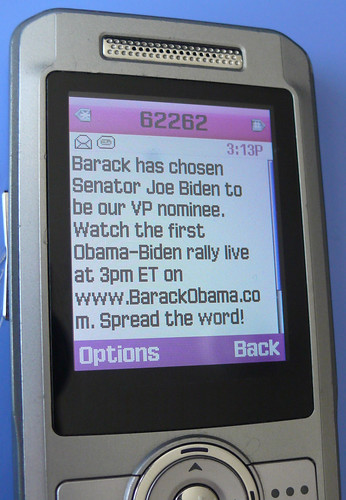
At 1:53a on Saturday morning as I was putting shoes on and getting ready to leave a friend's house, I got the text:
Obama Text


There has been some criticism that it was a sham, that people didn't find out before the media and were disappointed, that it was a waste of time and anticipation. I strongly disagree.

First of all, anybody who thought that a large-scale SMS like this could be pulled off without a hitch is foolish. Different carriers have different delays. I frequently get text messages 4 hours after they are originally sent to me. That's just how it is right now. The Obama text was deployed just after 3am EST, midnight here in San Francisco. I didn't get it until 1:53a my time, just before last call. And not only were the networks flooded with the messages coming out from the Obama campaign, they were flooded with people immediately forwarding the message onto their friends and subsequent SMS exchanges. I sent and received at least 20 text messages within a half hour of receiving my text. I do think it's a bummer that some people never got the SMS but I hardly think that's grounds to call it a scam.

Second, while the New York Times and other major papers put the news online immediately, thus before many people had received their texts, the announcement was absent from some of the print editions of major papers, including the New York Times and the Wall Street Journal. Why? Because the text was sent after most of the Saturday editions had long been put to bed and were peeling off the presses. Sending this kind of information after the major papers have gone to press has traditionally been considered political suicide, but the Obama campaign knew what they were doing. The information was disseminated digitally, not via newsstands. Some critics think the 3am timing was a last dig on Hillary, but I think it was less a dig and more recognizing the importance of that 3am response.

According to some complaints from people who never received the text, I was lucky to get mine at all. But I can honestly say that I've never been so excited to receive a text message. I was nowhere near a computer when the text came, and hadn't received any tips from friends elsewhere in the country, so it was nice to be able to go out, have fun, and receive news like this via 2am SMS. My only real disappointment is that the text didn't start with "Hi, this is Barry!"

It's important to keep in mind that this was an experiment and it was not executed perfectly, but it does serve as a proof of concept. But what other politician has tried something like this on such a large scale? It was a great way for the Obama campaign to harvest phone numbers and build quite a buzz, but it was also a bold use of mobile technology—and great practice for November. As a friend put it, "The blogosphere can't quite yet eclipse the major news media. Heck, twitterverse was convinced it was bloomberg before the runup that day."

Of course, Biden's support of the DMCA and his friendliness with the RIAA are whole different issues...

— Jess Hemerly, August 2008

Monday, July 7, 2008

Rethinking Free Speech Online [IFTF]

Institute for the Future, July 7, 2008 [Link]

We often think, talk, and write about social networking and public spaces online. But it's easy to forget an important part of the modern-day Internet: private companies rule the Web.

We often think, talk, and write about social networking and public spaces online. But it's easy to forget an important part of the modern-day Internet: private companies rule the Web. Yahoo, Google, Facebook, MySpace are private companies with payrolls, investors, and ultimate ownership over the spaces we use to share and collect information. Are they limiting free speech? Or are we foolish to think of our speech as something that should be "free" in spaces that depend on subscriptions or advertising to stay alive?

Every community and service has its own terms of service, its own set of community guidelines. And for as much as people feel they are being wrongly censored and that their First Amendment rights are violated, community guidelines online are really the equivalent of "No shirt, no shoes, no service": if you don't like these rules, find another place to post.


Photo by jkoshi

For example, at a gathering at a local San Francisco bar a few months ago, I met a Flickr employee whose role is, in part, to field complaints about inappropriate behavior on Flickr. He follows Flickr's set of guidelines in determining what should be made private and what is appropriate for the Flickr public. When it comes to nudity, he must adhere to the "south of the border" rule, where any below-the-belt nudity is stricken from public access. Whether it is art or pornography doesn't matter—Flickr has decided to avoid that debate altogether and draw its own line.

On a much smaller scale, privately hosted community forums frequently develop strict rules of conduct for members and appoint moderators to delete incendiary posts and, in extreme cases, ban frequent offenders from the forum altogether. Even blogs have moderators who remove incendiary comments that they deem irrelevant to the dialog. Banned users frequently complain about their rights to free speech, but in the end, the site's rules reign.

The AP's Anick Jesdanun considers this matter in his July 3rd article, "'Public' online spaces don't carry speech, rights":
While mindful of free speech and other rights, Yahoo and other companies say they must craft and enforce guidelines that go beyond legal requirements to protect their brands and foster safe, enjoyable communities — ones where minors may be roaming.

Guidelines help "engender a positive community experience," one to which users will want to return, said Anne Toth, Yahoo's vice president for policy.

[...]

Heather Champ, community director for Flickr, said the company crafts policies based on feedback from users and trains employees to weigh disputes fairly and consistently, though mistakes can happen.

"We're humans," she said. "We're pretty transparent when we make mistakes. We have a record of being good about stepping up and fessing up."

But that underscores another consequence of having online commons controlled by private corporations. Rules aren't always clear, enforcement is inconsistent, and users can find content removed or accounts terminated without a hearing. Appeals are solely at the service provider's discretion.

The implications become severe when you consider the accusations against Yahoo of working with the Chinese government to identify dissidents using the Internet to speak out against the government. That sort of activity may mar the company's image, but that doesn't undo the fact that users thought they were speaking anonymously in a worldwide forum, beyond the the scrutiny of the Chinese government. These companies know what you are doing online, and the recent Viacom v. YouTube ruling brings into question not only matters of free speech, but also privacy.

Jesdanun's article is an interesting read, and weighs the pros and cons of government intervention in assuring free speech rights online. But until those issues are worked out, as bottom-up as many of these services seem, there is always a ceiling: the company's bottom line.

— Jess Hemerly, July 2007

Thursday, April 3, 2008

Songbird: Future of the Free Media Web [IFTF]

Institute for the Future, April 4, 2008 [Link]

Two things we are beginning to talk about regularly at IFTF are open source and free media. Songbird, a media player in development by San Francisco's Pioneers of the Inevitable, harnesses both of these things.

Two things we are beginning to talk about regularly at IFTF are open source and free media. Songbird, a media player in development by San Francisco's Pioneers of the Inevitable, harnesses both of these things. Songbird recently released its 0.5 version, and while not quite ready for consumers yet, it is building a strong community of developers and users.

From their website:
Play music. Play the Web.

Songbird is a desktop media player mashed-up with the Web. Songbird is committed to playing the music you want, from the sites you want, on the devices you want, challenging the conventions of discovery, purchase, consumption and organization of music on the Internet.

Songbird is a player and a platform. Like Firefox, Songbird is an open source, Open Web project built on the Mozilla platform. Songbird provides a public playground for Web media mash-ups by providing developers with both desktop and Web APIs, developer resources and fostering Open Web media standards, to wit, an Open Media Web.

Built on Mozilla's XUL, Songbird is both a media player and web browser. By mashing up these applications, Songbird features a few interesting innovations. When surfing to an MP3 blog page, Songbird automatically sniffs out any media on the page and pops up a playlist of those tracks. Instead of having to download or play in a separate tab to test out the track, users can double click the song in the pop-up playlist to sample it. If you like it, you can simply click "Download" to save the song to your library. Once in your library, you can drag the track to a playlist or transfer it to a portable device. Songbird also lets you view your library in tag clouds and filter your library by metadata categories iTunes doesn't support.


Since it's open source, Songbird leverages an add-on platform for developers to create their own extensions and themes called "Feathers." There are already a good number of add-ons for Songbird, including a few that contextualize your music listening with metadata from all over the Web. My favorite thus far is an eMusic plugin that allows you to surf and download from eMusic directly through the player, bypassing eMusic's downloader, making the overall user experience much friendlier for eMusic users. Developers have also created device support for nearly every portable music device under the sun, including the iPod.


For audiophiles who scour the Internet for free media, Songbird is a great all-inclusive tool—a window to an Internet teeming with free media. The Internet provides the content, but Songbird helps your harvest, use, and make sense of it. As the community grows, it will be interesting to see what extensions people create and what kind of user base Songbird will foster. This recent release has brought them some good press, including MacLife and Wired. For more detailed information, check out the Songbird blog.

— Jess Hemerly,

Wednesday, June 20, 2007

Real World GarageBand [MacTribe]

MacTribe, June 2007

DIY finds some help.

Studio time, marketing, promotion, pressing, packaging, distribution... all of these things require money and inside connections for up-and-coming musicians. But as technology advances and the phrase "famous on the Internet" begins to translate to dollars, do-it-yourself (DIY) musicians find more ways to work effectively outside of the music industry's traditional system. Enter Apple's GarageBand. This application has become a creative catalyst for everyone from the average tinkerer to the signed artist. From full album production to long-distance collaboration to sketching new songs on the road, Apple's music editing application has given new meaning to the term "garage band," allowing the company to further entrench itself in the music industry.

A perfect example of the DIY band, Los Angeles-based Bastard Fairies put their entire album together in one week using GarageBand. The band picked up Fisher Price toys from thrift stores to add texture to the music, threw in some socially conscious lyrics, stitched everything together in GarageBand, and offer the album as a free download. Band member Robin Davey loves the simplicity of the program and believes it served as an enabler for the band. "It's the quickest way to get your ideas down," he says. "Once you actually open it up and realize how quickly you can build a track it definitely enables that creative process and takes away the need for expensive studios and things like that. Everything is there in one package."

The Fairies advertised their free album on YouTube with videos assembled in Final Cut Pro. One of the videos, a "commercial" for the album, featured an eight-year old girl talking about the perils of religion and the failures of an educational system that pushes religion instead of empathy. The video quickly became popular on YouTube, and criticism from Fox News pundit Bill O'Reilly unexpectedly boosted the DIY band's exposure. "People grabbed hold of [the video] and, because it was tagged at the end with the Bastard Fairies website, they discovered the album there," says Davey. "That led to it being most subscribed on YouTube."

Despite the popularity, the Bastard Fairies chose to keep with the DIY spirit and not profit off of the album in the wake of their celebrity status. They will offer a special version with five extra tracks and a bonus DVD for purchase, but the original album will always be free for download. "Because the album was done on a budget of about $10 there's no reason why we can't give it away," he says. "There's no one to tell us that we can't and also if we do that, people are going to download it. We're going to generate fans." Thanks to Apple's technology, they were able to successfully retain full control over the entire process, from recording to distribution and promotion.

Like cassette culture of the '80s, GarageBand is a way for new artists to record a demo, but unlike the '80s cassette culture, social networking sites like MySpace and YouTube allow artists to self-release and build a fan base before finding their way to the airwaves. An existing fan base gives them an advantage when it's time to shop for a label. "We're in this stage where you can do so much more by yourself and I think it's very empowering to be able to record yourself," says singer/songwriter Ari Heist. "As a musician, it's such a key thing because otherwise you'd be spending a whole lot of money to get other people to do it for you." Heist produced and recorded his 2006 EP, "The Green Room Sessions," in his Brooklyn apartment. He played every single instrument on the album—a feat in itself—and assembled the pieces with GarageBand. Unlike the Fairies, however, Heist has been signed to a major label, Columbia, for a few years. "I'm not the first to do this, but I'm really excited about it," he says, taking a break after performing at SXSW. "I use it all the time."

Even artists who don't record entire albums with the software find it a useful part of the creative process. Singer/songwriter Jann Klose uses GarageBand in conjunction with ProTools and Logic to collaborate on songs with his keyboardist. "When there’s a new song idea I usually dump it right into GarageBand," he says. Unlike Logic and Pro Tools, which consist of folders within a file, GarageBand creates a single all-inclusive file, making it easier for artists at different locations to collaborate. And since GarageBand files can be opened in Logic without needing conversion, Jann will open it up there in order to generate and print the arrangements for other parts of the ensemble. "My keyboardist and I go back and forth with the file and we can work on adding strings in MIDI thanks to the new MIDI capability in GarageBand."

GarageBand's ease of use combined with the portability of Mac laptops make it a great application for capturing ideas whenever and wherever they happen. For a touring musician, this is often the bus, the bar, or backstage. Adam Merrin of The 88 depended on GarageBand for the drums on his solo album, but his band, recently featured on the popular television show "The OC," also uses the application when they're on tour. "I remember being on the road and using it to record ideas while we were in the car," he says. "We can just open up the laptop and start creating melody ideas on it."

Apple's recent forays into music have proven incredibly successfully, and GarageBand is no exception. The program has already become popular with average Mac users who just like to geek out and play. Many companies also offer loops for users to download and manipulate. Communities on the Internet like MacJams and iCompositions provide forums for fans of the GarageBand to upload loops and tracks and share them with other members of the community. Nine Inch Nails frontman Trent Reznor has even gotten into the GarageBand spirit. He periodically releases tracks as GarageBand files and encourages user remixes. Since GarageBand is so easy to use, theoretically anyone can make music.

But could GarageBand make it too easy for anyone with a Mac and a mouse to have delusions of rock star grandeur? "No," says Adam Merrin. "The song is still the most important thing. It’s very easy and inexpensive for people to put out their own records but the best stuff is always well written." Robin Davey agrees there's no hope without some idea of what a song is all about. "That's the essential thing: the song that you start with," he says. "Without that you're not going to get anywhere."

As a viable option to expensive studio time, GarageBand will help good do-it-yourself artists emerge on little to no budgets. But unlike "American Idol," which offers the hope of three minutes of fame even if you sing like a jackal, some semblance of musical talent and a sense of creativity is a prerequisite for getting anywhere with the music you create, even in GarageBand. Still, the consensus is that it's worth digging into and exploring what GarageBand has to offer. "I couldn’t recommend it more," says Merrin. "The fact that it comes installed with all the Mac computers is the coolest thing of all." Robin Davey sees it as part of a trend in technology making artists more self-reliant. "I think that the more and more computers evolve, the easier it gets for artists to put their creativity down."

But while GarageBand won't replace the studio any time soon its rise is certainly not good news for everyone. Heist believes an easy and affordable program like GarageBand negatively impacts smaller independent studios who rely on the business of small up-and-coming bands. "You see a lot of studios going out of business, a lot of studios that were once very sought-after and had really nice stuff to offer, but you can create something that's as good or almost as good in your own home," he says. "It's a no brainer. You won't want to spend that much money everyday to go to a studio."

Jan Klose sees its accessibility as nothing but positive. "If you’re creative there’s a lot of things you can do with it right off the bat. The main thing is that you don’t have to spend a lot of money to get it since it comes with iLife and new Macs. The fact that it’s so fun and easy to use makes it an obvious choice."

Time will tell whether or not GarageBand will have a lasting impact on the music industry, but it's clear for now that Apple fortifies its place in the music scene with this DIY-inspired application. Combined with the ability to build a following on the Internet, GarageBand has the potential to revolutionize an entire segment of the digital music industry.

— Jess Hemerly, 2007

Saturday, February 3, 2007

Readers Write: Can Apple and the Tech Industry Be 'Green'? [AlterNet]

AlterNet, February 3, 2007 [Link]
Response to "Apple Computers: Fun For You, Toxic for the Environment", by AlterNet staff, with my response at the end.

Our readers questioned whether Apple deserved its low environmental rating from Greenpeace and what can be done to green the tech industry.

These days technology is so much a part of our lives that we sometimes forget to think about where it comes from -- and importantly, where it goes when we are done with it. This week we published a story by Jess Hemerly about Apple computers, which was recently ranked by Greenpeace at the bottom of the list of eco-friendly tech companies.

The story elicited a number of passionate responses from readers, some of whom felt the folks at Mac were unfairly targeted considering the rest of the industry's track record.

Greenman wrote:
Apple is certainly no worse than its peers, and is better than some, regarding the environment. Seriously, the idea that any computer is good for the environment is pretty crazy. There's nine times as many PC's as there are Apples in the trash heaps of the world, and there's not a nickel's worth of difference between an Apple carcass and a Dell carcass, I'd wager, in terms of harm to the environment.

As other posters have pointed out, what is needed for electronics and computers -- especially -- and for all products in general, is a pricing system that would include "cradle to grave" provisions for mitigating harm to the environment for the entire life of the product. Everything would quickly become of much higher quality, would last longer, and would be more expensive, too. That's the kind of carrot-and-stick regulation that government could impose, but doesn't for all the grubby reasons we are all too familiar with these days.

Other people also mentioned the issue of durability and thought that Apple's lifespan should be taken into consideration -- arguing that people go through their PCs quicker than their Macs.

In her article, Hemerly compared Apple's environmental policy to that of Dell, citing Dell's recent commitments to providing free recycling to their customers worldwide and their recent "Plant a Tree for Me" campaign that allows consumers to pay an extra $2 for their computer purchase to go towards reforestation.

But one reader said that that Dell's efforts were more symbolism than actually productive environmental efforts. Thoughtcriminal wrote:
Just because Dell allows you to make a $2 donation to a 'plant a tree campaign..." -- that makes them a responsible greenwashed company? What's needed is a generalized government-regulated e-waste recycling industry that provides safe working conditions; you could simply place a small tax on all computer and electronics gear sold in the U.S. to help fund such a program.

I mean, go down to your nursery, buy some trees, and plant them yourself -- your $2 feel-good donation to Dell is nothing but green marketing (that you get to pay for!)

Several other readers also thought that since Apple was abiding by the laws, they shouldn't be singled out for punishment, but did suggest that this is a problem that should be addressed with federal regulation.

TheGrunger wrote:
Dell may be marginally better than Apple -- but neither one is going to bend over backwards to do what is right if it cuts too far into their bottom line.

While I think it is valuable to point out things like this, unless they are actually breaking the law I don't see any value in singling out Apple or any other company. We cannot expect corporations to do the right thing (in any situation, environmental or otherwise) if there are not strict regulations in place to punish them harshly for doing the wrong thing.

The problem is the entire corporate system and the weak regulatory laws of our government -- that is where we should focus our efforts. That is the only way to force companies like Apple to pay attention.

While some people felt that it was the government's job to legislate change, others found the article helpful in letting consumers know that they can begin demanding that Apple and other companies, start doing more to protect the environment.

Ghoulman, a Mac user, wrote: "I think all the right points are put out in this article. Computers, and electronics in general, are a dirty little landfill secret ... I'm glad someone is upping the environmental anti."

Likewise LarryGroff wrote:
I am also a long time Mac and PC user who is very concerned about the environmental impact of my computers. I would agree with those who take Jess Hemerly to task for not investigating thoroughly enough about Apple's environmental record and the superficiality and grandstanding of Greenpeace's Green my Apple campaign.

However, Apple is a large corporation whose business goals are far ahead of any other concern, to think otherwise is naive. Apple is not a movement regardless of how we might wish it so. But it is good that Apple is getting the green lights blasted on its facade as it may prod them to indeed move ahead and make their environmental decisions even more carefully and boldly if they fear that their reputation and popularity are at risk.


Hemerly herself, responded to our readers' comments and asked that we see the bigger picture intended in her piece.

She wrote:

First, I can assure you that I did very thorough research that included conversations with both Apple and Greenpeace. The Apple spokesperson I talked to was very friendly but there was little room for discussion because that's simply how the company operates. She walked me through their site and I read everything. I wrote my piece based on the information I was provided. If Steve Jobs wants to sit down with me and talk about environmental policy and the Greenpeace campaign, I will jump at the chance. As it stands, that hasn't been presented as an option. The spokesperson from Apple directed me to the Roughly Drafted site, which is a great spin on things but it is, like my own piece, one writer's conclusions. As the reader, you are your own filter and it's up to you to choose what you want to accept or dismiss.

I do not envision Steve Jobs as some evil king looking down on a polluted world from his gleaming white polymer spire. I do envision Apple as a company of innovation and one that has in its own words asked people to "Think Different." And now that Greenpeace has decided to turn it around and ask them to do the same, everyone is up in arms. Is it because Greenpeace is the organization doing the asking? Greenpeace is not hurting Apple. Apple continues to gain market share and turn in record profits as a result of the Halo Effect the iPod spawned. Greenpeace is simply asking a company that champions innovation to pitch in and be as innovative when it comes to the environment.

Michael Dell and his company were used in this piece to contrast Apple's tight-lipped attitude toward environmental policy. Dell is not perfect and neither is Apple, or Nokia, or Fujitsu, or any of the companies who make the devices we take for granted everyday. They all have serious faults and questionable practices when it comes to various aspects of business. But is Dell bringing green ideas to the table? Absolutely. And a table full of ideas is where change begins.

Yes, better regulations should exist, and so should a litany of regulations that require all companies, technology and otherwise, to do more to help the environment. But given the political climate of the United States right now, it's unlikely that any progress will be made here anytime soon. Thus, Greenpeace has been forced to turn its efforts toward something that can produce results. Have we become so jaded that we are willing to give any company a bye just because it's "business as usual"?

Of course, Apple is not the only company contributing to the e-waste mess. But they are the only company that makes beautiful machines that people are willing to shell out extra money to carry with them for reasons ranging from cool factor to basic operation. Is it really so crazy to ask them to make their beautiful machines cleaner than the rest, to really go out and set the standard? They are not the "little guy" anymore. They're a serious contender and that becomes more evident every time they gain a percentage of the PC market share.

You ask me, "Why Apple?" I ask you, "Why NOT Apple?"

In the end, there is no doubt that the technology we use is toxic -- and that more can and should be done to ensure that it is made and disposed of as safely as possible. It is always easier to point to someone else to take the responsibility for making that happen -- but whether we want the government to regulate it or companies to prioritize it -- it is still up to us to make that happen.

Tuesday, January 30, 2007

Apple Computers: Fun for You, Toxic for the Environment [AlterNet]

AlterNet, January 30, 2007 [Link]

Apple positions itself as the technological haven for the hip, the progressive and the revolutionary. But when it comes to the environment, Apple is quite out of touch.

Before an audience of tech lovers, developers, and Mac enthusiasts, Steve Jobs unveiled the creation everyone has been speculating about for years: the iPhone. Fans hung on every word as the Apple CEO stood onstage during his keynote address at the Macworld Expo in San Francisco. Dressed in a black mock turtleneck, he told the rapt crowd about patents for polymers, innovative user interfaces and corporate partnerships.

Jobs went on for nearly two hours about how amazing and revolutionary his gadget will be. But he did not mention the company's environmental policy once.

Then again, who talks about environmental policy at an electronics fair? Michael Dell does. At the Consumer Electronics Show in Las Vegas during the second week of January, the head of struggling Dell Computers raised the stakes for the entire PC industry: "I challenge every PC maker to join us in providing free recycling for every customer in every country ... all the time -- no exceptions," he said.

Jobs and the PR wizards at Apple have done a fantastic job of positioning the company as the technological haven for the hip, the progressive and the revolutionary. But when it comes to the environment, Apple is out of touch.

In December of 2006, Greenpeace released a report ranking the overall environmental policy of major technology companies. Dell was at the top but Apple found itself at the bottom. While top companies like Dell and Nokia have made great strides to eliminate the most toxic chemicals from their products and offer strong recycling programs, Apple has not.

"Today you can't recycle most of these products because you're recycling toxic waste," says Rick Hind, legislative director of the Greenpeace Toxic Campaign. "We're looking at it from a complete life cycle approach, from where we make these to where they end up. Twenty to 50 million tons of e-waste a year end up in China; that [e-waste] is endangering to migrant families trying to remove a very small percentage of the materials for recycling."

Following the release of the report, Greenpeace launched "GreenMyApple," a full-force PR campaign complete with an informational website that impressively mimics Apple's website. Activists distributed flyers outside of the Moscone Center during the full week of Macworld Expo. The group also altered the video of the famous Steve Jobs keynote address, creating their fantasy version of the keynote in which Jobs would announce that Apple plans not only to step up their environmental policies but will make environmental responsibility a part of the company's identity.

To date, Apple has done only what is legally required. They are in compliance with RoHS standards ("the restriction of the use of certain hazardous substances in electrical and electronic equipment"), which were put in place in the European Union in July 2006. Pressure from environmental groups like the Computer Take Back Campaign combined with changing legal standards forced Apple to come up with a recycling program that at least looked like it was green -- but that's about it.

Apple refuses to make "green" part of their image. Just finding the environmental section on its website requires either a search of the site or knowing that "apple.com/environment" will get you there. Among all of the tabs in the navigation bar at the top of the pages, "Environment" is nowhere to be found. "As their website shows, green can be turned into greenwash," says Hind. "What we're talking about is measuring them based on toxics and recycling that is a serious physical problem."

Apple spokesperson Kristin Huguet provided the official Apple response to the Greenpeace ranking and campaign: "We disagree with Greenpeace's rating and the criteria they chose. Apple has a strong environmental track record and has led the industry in restricting and banning toxic substances such as mercury, cadmium, hexavelent chromium, as well as many brominated flame retardants. We have also completely eliminated CRT monitors, which contain lead, from our product line. Apple desktops, notebooks, and displays, each score best in class in the new EPA ranking system EPEAT, which uses new international standards set by IEEE."

Apple contends that it is as green as it needs to be and supports that contention with the Silver medal it earned from the EPA's U.S. Electronic Product Environmental Assessment Tool (EPEAT) back in July of 2006. But the sets of criteria used by Greenpeace and the EPA are very different.

For one, the EPA criteria apply to specific products and apply only to stateside programs. Greenpeace's criteria evaluate the company as a whole and are more critical. In a Jan. 12 article on IT Week's Green Business News, Scot Case, marketing director at EPEAT, said, "My initial reaction was that comparing the two systems was like comparing apples and oranges, but on closer inspection it is more like comparing apples and cows."

Yet Apple uses the EPEAT results to refute the Greenpeace grade. Obvious disparities aside, even though Apple did well by EPEAT standards, it still didn't earn a Gold medal. Shouldn't an industry leader strive to achieve the highest possible grade?

Through its "Think Different" campaign a few years ago, Apple positioned itself as the "alternative" computer manufacturer using pictures of idols ranging from Einstein to Gandhi. It targeted a particular segment of the consumer computer market, and to this day, many of its users remain loyal. Many of those users also happen to be socially, politically and environmentally conscious. Yet, Apple has been resistant to take the lead, and Jobs himself has been, at times, downright indignant.

In 2005, in the wake of criticism from environmental organization Silicon Valley Toxic Coalition, Jobs commented on Apple's being "singled out" and called it "bullshit." Barbara Kyle at the Computer Take Back Campaign, a group instrumental in the first push for Apple to establish a recycling program, says, "They're the company that 'thinks different.' We were puzzled all the way along with Apple's behavior."

Since Apple has only gone as far as it needs to, the company already has a lot of catching up to do in order to keep up with other companies in the market who make green policy a priority.

On Jan. 10, 2007, Dell announced that it had teamed up with the Conservation Fund and carbonfund.org to offer a program called "Plant a Tree for Me." When a new Dell computer is purchased, the consumer can opt to add an extra $2 to the cost of the computer. That money will be turned over by Dell to its environmental partners and be dedicated to reforestation. Dell also already offers free recycling of all of its old systems as well as other brands' systems to new Dell customers. Those not buying new Dell systems or recycling old ones can send their e-waste to Dell to be recycled for less than the California sales tax on a new MacBook: $10 per box under 50 lbs.

Compare Dell's program to that of Apple. Before 2005, Apple's recycling programs were virtually nonexistent. Recycling an old Mac meant finding other uses, like turning them into MacQuariums, iMacquariums, or, for G4 Cube owners, Cubequariums.

It has since developed recycling programs in the continental United States and only in foreign countries where mandated by law. It accepts computers only when you buy a new Mac from an Apple retail store or through Apple's online store, and the box you click before checkout is not easy to find.

"It's one thing to say that we're going to have another take-back program, but it's another to say that we're really going to try to make people use it," says Kyle. In addition to the poorly publicized recycling program, Apple is no longer making products to last. "Recycling should be the second thing you do after reusing and extending the life span," says Hind. "That is not an environmental obstacle, it's an intentional obsolescence designed to sell more products."

While Bill Gates publicizes his dedication to philanthropy and Michael Dell rolls out environmentally conscious policy after policy, Steve Jobs is prank-calling Starbucks with the iPhone. And now Greenpeace is calling Apple out on its hypocrisy.

"It's a great irony that the company that markets itself as revolutionary is actually the most reactionary on these policies compared to all of the other major companies," comments Hind. "If once a big user says 'I want it toxic-free,' the engineers and other suppliers are going to scramble to make that; they want that customer. It is crucial that the corporate policies of these companies take the lead."

It is the contradiction between image and action, though, that gives Greenpeace hope that Apple will eventually come around. "That kind of contradiction can't be sustained if you continue with that kind of marketing profile," says Hind. "They have a lot of customers who are critical thinkers, and they have a lot of future customers who are critical thinkers. Don't try to look green, be green."

Barbara Kyle is also hopeful. "If Apple is really willing to make the commitment and actually follow through with it on a number of things -- on takeback, on green design, on any number of things -- they have a chance to shape people's consumer behavior in a way that I think other companies are really challenged to do," says Kyle. "Apple can make this stuff cool."

— Jess Hemerly, 2007

Monday, January 8, 2007

MySpace Virtual Demo [MacTribe]

MacTribe, January 2007 [Link Part 1 & Part 2], also appeared in MacTribe's first print edition.

How MySpace Connects Artists, Labels, and Fans

Teenagers adore it. Young adults use it to pass the time at lame desk jobs and track down people from their past. Predators use it to zero in on potential victims. Parents fear it more than any parent feared the Beatles and Elvis's gyrating hips combined, and other people just think it's a stupid waste of time and energy. So what could possibly make MySpace useful beyond worldwide Internet distraction?

Music, that's what.

Before the dawn of the Internet age, when everybody suddenly fancied themselves an expert in web site design, musicians looking to promote their work had to do so through analog means: demo tapes, flyers, performances at artist showcases, etc. And just because they got a gig or found an A&R exec who’d bite doesn’t mean they’d have the one thing that can keep a musician’s career going for a long time: fans.

The digital revolution made it easy to upload tracks to a server and put them on the Internet, where everybody has access to them. But band web pages required at least rudimentary HTML skills, and not everyone broke down and bought a copy of HTML for Dummies. Now, anybody with a few tracks, a computer, and an Internet connection can create a self-promotion music page thanks to the controversial juggernaut of a social networking site, MySpace.

A few months ago, I received a MySpace message from Karl Miles, a former high school classmate who I’ve been out of touch with for 7 years, asking me to go to his MySpace Music page and check out his tracks. He's starting a career as a solo folk artist and found me through the magic of MySpace. He wanted to know what I thought of his music so I went to his profile and listened to his tracks, played through the built-in mini player. Since he made them available for free I was also able to download them, save them to my computer, and play them for my friends.

Karl admits that part of the attraction to MySpace was its ease of use, having put off setting up a "real" site for far too long. And he doesn't subscribe to the delusion that MySpace will make him famous. "I find an open mic will generate more attention," he says. "It is more likely a person will hear about me some where else and check if I'm on MySpace." He certainly doesn't believe that MySpace is an easy way out of a musician's traditional struggle to be heard. "You still have to do leg work, play gigs," he says. "If you get a buzz outside MySpace maybe you can get one on MySpace. But I don't think MySpace will create one for you on its own."

Ezra Caraeff, owner of Portland-based indie label Slowdance Records, sees many bands are not as realistic as Miles. Instead they believe that a MySpace page and 400,000 friends is a quick ticket to Mick Jagger status. "I think a lot of bands think friends equal sales," he explains. "But those are the same bands who think emailing me to 'check them out' or 'you should sign us, we RoCk' [sic] is a good idea as well."

The problem with MySpace for many hopeful musicians is that the "adding friends" feature creates a false sense of audience, and with that false sense comes an inflated perception of fame. There are actually programs that crawl MySpace on a band’s behalf and add friends at random, an act equivalent to email spamming. "Since it's so lawless," says Caraeff, "it's a chance for these unknown bands to be on an even plane with known artists. Like, we don't have a record or play shows, but we have as many friends as Hoobastank." Caraeff also worries that the meaning of the word “friend” will be forever corrupted by the MySpace “friend” system.

Yet despite this grand delusion factor, Ezra's label insists that all of their artists have MySpace pages, most of which are maintained by interns. Even his label itself has a page, and Slowdance has used the bulletin feature to reach bands' audiences—although Ezra still thinks email blasts are more direct and consequently much more effective. A blog post on the profile—which touts the label as the "Best. Label. Ever."—begs musicians not to spam them with requests to listen to their tracks.

As the head of a label, Caraeff sees the proliferation of bands with little talent but a lot of friends as just another stage in the evolution of the music industry. "My brother used to work at Capitol Records and I remember going there when I was in like 10th grade and seeing crates of demos in this dumpster," he reminisces. "It's a very sobering thing. MySpace reminds me of that on a daily basis… so much delusion."

But not every band that’s active on MySpace is mired in delusion. One band that has found success via the Internet is Saosin, a post-hardcore band who got their start by posting tracks to a variety of Internet music forums. Their tracks caught on, and their first show was jammed with kids clamoring to see the band they'd heard on the Internet. They now have a deal Capitol Records and just finished their third Warped Tour.

Saosin maintains a MySpace page. In an interview with bassist Chris Sorensen he made it clear that the guys in the band actually use it. Part of the fun for Chris is the ability to listen to a band’s tracks on one page and then “go check out some hot babe’s page.” The band’s page boasts over 178,000 friends and actual band members answer messages.

Another up-and-coming band that actively uses MySpace is Holiday and the Adventure Pop Collective, an Americana group from the San Diego area that tours widely all over California. Recently nominated for the title of Best American Band for the San Diego Music Awards, band member Louis Caverly says they use it for at least an hour every day when they’re not on the road. “MySpace is a community and for any community to work you have to talk to the people,” says Caverly. “It is pretty rad to talk directly with folks, be it potential fans or possibly a personal hero that you stumble upon.”

At first it just seemed like an easy place to upload tracks but Caverly now believes that it is a great tool to have in the arsenal as they build their career. They will solicit potential fans but not by using a “friend adder.” Instead, they take the time to surf the site for people with tastes that match their style and for bands that play a similar kind of music. For them, it’s really about logging on and making it work. “MySpace will help us to increase our audience because if you use it, it works.”

Shawn Hatfield, an experimental electronic musician in San Francisco, has a similar philosophy when it comes to reaching out through MySpace. "I already had a personal page and figured it would be a good place to give my fans access to information on upcoming projects and also a way for them to feel like they've had a personal connection with me that goes beyond just owning the CD or record," he says. Hatfield has had offers to play gigs overseas through MySpace and believes that MySpace has the potential to help him gain enough attention to score larger gigs.

But how realistic is it that the music industry sees these band pages as anything more than must-have novelties for their artists? Well, if an artist catches the eye of an active MySpace user who happens to work in A&R (artist and repertoire, in case you have always wondered what it stood for), it’s very realistic. And such A&R reps do exist. Tony Kiewel, head of A&R for indie label SubPop, is one active user who believes that MySpace is something more than just a project for interns or a collective unheard cry for attention. "I definitely look at it to hear new stuff both as a fan of music and as an A&R guy," he says. "If I like a band I'll look at their page and often times end up listening to their friends’ bands that they have in the top 10 or whatever that little list is." So there's no algorithm that converts MySpace friends to record sales but who a musician is connected to and how may lead to an important discovery by the right person.

Kiewell also relies on the site as a research tool and a quick way to zero in on what people are listening to. "You can't Google 'The Books' and find anything helpful about the band without some serious digging," Kiewell explains. “If I go to MySpace and do a band name search I can find them in seconds." And it's not just a band bio that you'll find; it’s an interactive page full of information. "I can hear them. I can see where they're from. I can see who they're fans of," says Kiewell.

And for musicians, the ability to check out who other musicians are into makes it an extremely useful networking tool. Solo artist Lia Rose experienced this first hand when one of her favorite indie musicians, Damien Jurado, left a comment on her MySpace music page. “I could hardly believe it, and of course returned the sentiment with a comment on his page,” she says. That comment led to an interesting chain of events for Rose. A member of a band in Holland, Winterbirds, found Rose’s comment on Jurado’s page and they added each other as friends. “After about a year of corresponding,” she tells me, “he gives me an internet music challenge by sending a song with just guitar and inviting me to write lyrics and melody and send some vocals back.” This correspondence turned into a project called Weatherkingdom that, naturally, has its own MySpace page too.

MySpace is more than just another venue for Internet voyeurism—it is actually a fantastic tool for labels, fans, and artists alike. “The real take-a-ways include finding other artists to play shows with, Internet radio stations to spin our songs, industry contacts, far away friends and folks that can help our career grow,” believes Louis Caverly. And the recent announcement that MySpace has teamed up with Snocap to allow artists to sell their tracks directly through MySpace pages will only make things more interesting. “I think it will be the great equalizer for those bands that hoard ‘friends,’” Caraeff contends. “They will soon find out the sobering results of 40,000 friends and $6.00 in total downloads.”

But will the day come when a label “discovers” a band through their MySpace page? "It's totally possible," Kiewell of SubPop predicts. "It hasn't happened yet but I bet it will soon.”

— Jess Hemerly 2007

Sunday, September 14, 2003

Recording industry wears the black hat in MP3 fight [The Morning Call]

The Morning Call, September 14, 2003
The girl, who resides in a housing project with her family, reportedly settled with the RIAA for $2,000. The RIAA offered "amnesty" to those who turn themselves in for intellectual property law violation, agreeing that a notarized, signed contract and a promise of deleted MP3s will protect them from future subpoenas. They do not, however, guarantee protection from lawsuits brought by individual artists who may seek to recoup losses, nor do they promise to keep the amnesty list from angry songwriters, artists and labels. In other words, the amnesty offer may be little more than an attempt to bait more file-sharers into paying for the music they have downloaded for free.

To make up for years of ignorance to burgeoning technology, the Recording Industry Association of America has subpoenaed everyone—major universities, individual users with "too many" files ... and a 12-year-old girl in New York City. It says they are violating intellectual property laws.

The girl, who resides in a housing project with her family, reportedly settled with the RIAA for $2,000. The RIAA offered "amnesty" to those who turn themselves in for intellectual property law violation, agreeing that a notarized, signed contract and a promise of deleted MP3s will protect them from future subpoenas. They do not, however, guarantee protection from lawsuits brought by individual artists who may seek to recoup losses, nor do they promise to keep the amnesty list from angry songwriters, artists and labels. In other words, the amnesty offer may be little more than an attempt to bait more file-sharers into paying for the music they have downloaded for free.

Internet-savvy teenagers have been trading music online since the early 1990s through FTP servers, a system that allows users to grant permission to other users to log directly into their files. It wasn't until Napster became the vogue in 1999, (a user-friendly file- sharing program that helped users unfamiliar with the technology of the FTP server), that file sharing became an epidemic. Why head to the mall and pay $15 for a CD when you can type "Britney Spears" into a box and see every track on her latest album and previous albums fill the screen before you?

A CD-R, the blank CD onto which file-sharers burn their music, costs about 34 cents. The music comes free. With this popular new network and user-friendly search capabilities, the allowances of America's teenagers suddenly went a lot further when it came to music. You didn't need to know anything about the technology -- you just needed a computer, a keyboard, a mouse and free space on your hard drive.

It took the RIAA years to realize that people were getting their major label artists for free via the information superhighway. In 2001, after a long legal battle, Napster fell to the giant, shut down its network and agreed to pay damages to labels and songwriters. But as strikes against Napster increased and its downfall became clearly inevitable, other peer-to-peer (or P2P) programs developed. Kazaa, Morpheus and Audiogalaxy allowed users to access music directories of any user willing to share and download files directly from another user. P2P filled Napster's place. But the RIAA made no attempt to stop it, and now, two years later, they seek to recoup their losses with a vengeance.

The subpoenas, the threats and the promises of amnesty are little more than heavy-handed tactics commissioned by an organization seeking to protect the financial interests of major labels, not in the interest of musicians. They want to fine offenders anywhere from $7,000 to $150,000 per song. Yes, file sharing is a violation of copyright law, making users digital music pirates. They are, in effect, stealing. But the punishments for intellectual theft are not simply excessive; they are preposterous. "Last time I stole a CD from a music store," one user remarks, "I didn't need to pay a $1.5 million fine for getting caught."

The RIAA rests on the assumption that it is losing money because of file sharing. But the money-losing argument rests on the assumption that musical pirates would have bought the CD in the first place. At $17 apiece from most major labels, this is simply not the case. Only one label so far, Universal, has realized that exorbitant pricing of plastic and CDs may have something to do with the decline in sales. They have lower their CD prices to $13. But their efforts to assuage a dissatisfied public may have come too late.

File sharing is not unique to the United States. However, not a single association in another part of the world has acted with the same fervor as the RIAA. Of course, no nation has as stringent copyright laws as does the United States. While RIAA scare tactics may put an end to the free music phenomenon on the mainstream, it will not end in the bigger picture. As the industry goes after P2P users, it doesn't realize that those in the know are going underground in rebellion and will continue to do so every time the RIAA catches on to a new technology.

Until the American recording industry embraces the technology, they will always be a few megabytes behind the pioneers of the digital frontier. And as long as the RIAA attempts to make examples of college students and 12-year-old girls, they—not the file-sharers—will seem like the criminals to the American public.

Jessica Hemerly of New Tripoli is a recent graduate of New York University and is working for the National Review.