Showing posts with label Politics. Show all posts

Monday, August 25, 2008

Obama "First to Know" Text: Success or Sham? [IFTF]

Institute for the Future, August 25, 2008 [Link]

For some people, the holiday season is the most wonderful time of the year. For me, it's presidential election season. There is no such thing as too much information or oversaturation. Given my obsession, it was only natural for me to sign up for Barack Obama's "First to Know" text message campaign.

I kept my phone out all day Friday anxiously awaiting the text between refreshes of Inkling's Obama-VP prediction markets. (I wasn't the only one.) But by the end of the work day, the text hadn't come, and word from the Internets said that the text would come Saturday.
At 1:53a on Saturday morning as I was putting shoes on and getting ready to leave a friend's house, I got the text:
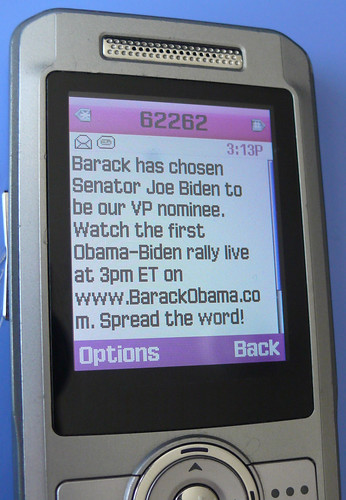
Obama Text


There has been some criticism that it was a sham, that people didn't find out before the media and were disappointed, that it was a waste of time and anticipation. I strongly disagree.

First of all, anybody who thought that a large-scale SMS like this could be pulled off without a hitch is foolish. Different carriers have different delays. I frequently get text messages 4 hours after they are originally sent to me. That's just how it is right now. The Obama text was deployed just after 3am EST, midnight here in San Francisco. I didn't get it until 1:53a my time, just before last call. And not only were the networks flooded with the messages coming out from the Obama campaign, they were flooded with people immediately forwarding the message onto their friends and subsequent SMS exchanges. I sent and received at least 20 text messages within a half hour of receiving my text. I do think it's a bummer that some people never got the SMS but I hardly think that's grounds to call it a scam.

Second, while the New York Times and other major papers put the news online immediately, thus before many people had received their texts, the announcement was absent from some of the print editions of major papers, including the New York Times and the Wall Street Journal. Why? Because the text was sent after most of the Saturday editions had long been put to bed and were peeling off the presses. Sending this kind of information after the major papers have gone to press has traditionally been considered political suicide, but the Obama campaign knew what they were doing. The information was disseminated digitally, not via newsstands. Some critics think the 3am timing was a last dig on Hillary, but I think it was less a dig and more recognizing the importance of that 3am response.

According to some complaints from people who never received the text, I was lucky to get mine at all. But I can honestly say that I've never been so excited to receive a text message. I was nowhere near a computer when the text came, and hadn't received any tips from friends elsewhere in the country, so it was nice to be able to go out, have fun, and receive news like this via 2am SMS. My only real disappointment is that the text didn't start with "Hi, this is Barry!"

It's important to keep in mind that this was an experiment and it was not executed perfectly, but it does serve as a proof of concept. But what other politician has tried something like this on such a large scale? It was a great way for the Obama campaign to harvest phone numbers and build quite a buzz, but it was also a bold use of mobile technology—and great practice for November. As a friend put it, "The blogosphere can't quite yet eclipse the major news media. Heck, twitterverse was convinced it was bloomberg before the runup that day."

Of course, Biden's support of the DMCA and his friendliness with the RIAA are whole different issues...

— Jess Hemerly, August 2008

Sunday, August 17, 2003

Counterpoint: ...While Dean appeal feels like 1972 to youth [The Morning Call]

The Morning Call, August 17, 2003
I envisioned a grass roots campaign similar to that of McGovern, where the youth vote and youth participation would lift him from underdog to front-runner during the primaries and carry him to the convention in Boston to cinch the nomination. McGovern went wrong in selecting as vice president the moderate Thomas Eagleton to placate the Chicago political machine. (And it didn't help that Eagleton's past mental-health treatment became an issue.) Dean must not make a similar error. If he does, the Democratic Party's fears will come true and history will repeat the Republican victory of 1972. A good running mate might be Gen. Wesley Clark, who would give Dean an opportunity to show that he's not anti-military, just anti- senseless war on foreign soil.

By now, everyone has heard of the once-unknown former governor of Vermont, Howard Dean. When I picked him as my horse for the race to 2004 in January, few agreed, but all assured me he didn't stand a chance against the big boys. Those people were wrong.

I was a student of politics at the time and am a registered Democrat, so it wasn't really too premature for me to start checking out the possibilities for the presidential election. I found a fantastic Web site recently created and maintained by students at George Washington University. The students had compiled a preliminary list of potential candidates for the Democratic nomination. On the list were those now in contention, or at least in media-speculated contention, including John Edwards, John Kerry, Joe Lieberman, and Dr. Howard Dean. The site contained links to speeches made by each, as well as general information about their political alignments.

A half-ream of printer paper and hours of reading later, I had my favorite. He seemed to have the purest motives, a liberal with a fiscally conservative streak, and I liked what the man had to say. As governor of Vermont, he has managed to create the best state health-care system in the nation. And although the United States is obviously far larger than Vermont, success on a smaller scale shows at least an ability to organize, react, and provide for constituents. The only part of his platform I found troubling was his opposition to gun control, but there is, after all, no such thing as perfect in politics. Betting against the odds, I decided that I'd like to see Howard Dean win the Democratic nomination.

I immediately realized the similarities between Dean and Richard Nixon's Democratic challenger in 1972, George McGovern. Like McGovern in 1972, Dean of 2004 comes off as a progressive candidate who has great ideas and would bring a refreshing change to the White House. The difference with Dean is that while he's liberal on social issues, he knows how to handle money.

Although Vermont has no statute requiring a balanced budget, Dean did it consistently. Dean managed an economy on a microcosmic level of the nation. When he was a candidate, Sen. McGovern had accomplished nothing even remotely close to what Dean has done in Vermont.

I envisioned a grass roots campaign similar to that of McGovern, where the youth vote and youth participation would lift him from underdog to front-runner during the primaries and carry him to the convention in Boston to cinch the nomination. McGovern went wrong in selecting as vice president the moderate Thomas Eagleton to placate the Chicago political machine. (And it didn't help that Eagleton's past mental-health treatment became an issue.) Dean must not make a similar error. If he does, the Democratic Party's fears will come true and history will repeat the Republican victory of 1972. A good running mate might be Gen. Wesley Clark, who would give Dean an opportunity to show that he's not anti-military, just anti- senseless war on foreign soil.

McGovern's success was vested in the loyalty of a bloc of voters, the baby boomers who had just ripened to voting age. They had been watching their friends go to Vietnam for nearly a decade and wanted the war to end. McGovern was the person to end it. Beginning with Iowa, McGovern proved how powerful the nation's disenchanted youth could be when they leveraged their voices in the political arena. His campaign staff consisted of kids. The times were a-changin' and America's youth were ready.

Dean's campaign has looked much like that of McGovern from the start. He charged out of the gates with a way to compete on the same ground as the big money machine of the Bush camp. He has unlocked a resource previously untapped, the Internet, and continues to make it work for him. He has used communications technology to reach disaffected voters, who now feel they have something to be excited about.

In an arena where big money generally determines the victor, Dean is giving the boys, both Democratic and Republican, a run for their big money. But he is not yet playing the politician game; right now, he's playing the money game, and he's playing it well. His weakness is his image. Dean needs to convince people that while he's tough on the issues, he would also be a great guy to have over for dinner.

Dean's ability to come from virtual unknown to media darling by circumventing the fundraising circuit via virtual campaigning should be proof enough that the self-proclaimed "Birkenstock" candidate from Vermont is no joke. In him, young people see a savvy, intelligent man ready to push in a new direction. He convinces young people that government is in their hands. He even makes us believe that the end of American Corporate Democracy is closer than we think.

Jessica Hemerly of New Tripoli is working in Washington, D.C.

Friday, August 1, 2003

Sen. Biden's anti-rave bill is generational war on youth [The Morning Call]

The Morning Call, August 1, 2003
The amendment has nothing to do with missing children and is, in fact, an expansion of the Controlled Substance Act, affectionately known as the "crack house statute." The word RAVE in the 2001 draft is an acronym for the bill as well as the name for a kind of party where, according to [Joseph Biden], people are vulnerable to Ecstasy. A rave is a large electronic music party held in space leased to promoters. The promoters and organizers book a list of DJs who will draw a crowd and provide music. A rave generally lasts all night and often well into the early morning, and kids spend the time dancing and socializing. Some attendees do use drugs, but owners do not support the circulation of drugs. Under this act, any property owner who hosts a party at which attendees buy, sell, or consume illegal drugs, regardless of measures taken by the owner to prevent such behavior, stands to face a hefty fine—and nine years in prison.

In American culture, history repeats itself and youth culture remains perpetually under fire. Rock and roll has been a threat to the moral fabric of American society for almost 50 years. Yet the baby boomers are in control and seem to have turned out okay, despite Haight-Ashbury and Elvis's gyrating hips. Older generations fear what the youth embrace.

Youth culture is under fire once again and this time electronic music is the culprit. Kids, electronic music, and the drug Ecstasy have become synonymous in the eyes of the law.

Democratic Sen. Joseph Biden of Delaware used the PROTECT Act, a piece of necessary legislation that expanded the Amber Alert, as a Trojan horse for a completely unrelated amendment to the federal drug code. Formerly known as the RAVE (Reducing Americans' Vulnerability to Ecstasy) Act, the Illicit Drug Anti-Proliferation Act of 2003 failed to successfully pass through any Congressional committees. Undeterred, Sen. Biden managed to tack a watered-down version of the RAVE Act onto the PROTECT Act on April 30.

The amendment has nothing to do with missing children and is, in fact, an expansion of the Controlled Substance Act, affectionately known as the "crack house statute." The word RAVE in the 2001 draft is an acronym for the bill as well as the name for a kind of party where, according to Biden, people are vulnerable to Ecstasy. A rave is a large electronic music party held in space leased to promoters. The promoters and organizers book a list of DJs who will draw a crowd and provide music. A rave generally lasts all night and often well into the early morning, and kids spend the time dancing and socializing. Some attendees do use drugs, but owners do not support the circulation of drugs. Under this act, any property owner who hosts a party at which attendees buy, sell, or consume illegal drugs, regardless of measures taken by the owner to prevent such behavior, stands to face a hefty fine -- and nine years in prison.

I do not condone the use of Ecstasy. But to prosecute property owners who provide their space for a rave under the same law that we use to lock up crack house owners is a gross injustice. Every rave I have been to in the last four years has taken every possible step to make sure that illicit substances do not enter. The organizers hire bouncers who conduct reasonably thorough searches at the door to ensure that attendees are not transporting drugs and they circulate bouncers throughout the party to watch out for illicit substance exchanges. The door searches are so thorough that I've had the contents of my bag dumped out, been asked to take my hair down, and even had to remove my shoes and socks. Drug use is not supported and property owners should not be held responsible for kids who sneak Ecstasy in behind their ears.

The original bill outlined its findings in greater detail than the one passed with the PROTECT Act of this year, but the target is still the same. The Congressional Record includes Sen. Biden's introduction of the law in which he makes it abundantly clear that raves are the target. Biden makes promoters out to be evil corruptors of our nation's youth, stating, "Some supplement their profits from the $10 to $50 cover charge to enter the club by selling popular Ecstasy paraphernalia such as baby pacifiers, glow sticks, or mentholated inhalers. And predatory party organizers know that Ecstasy raises the core body temperature and makes the user extremely thirsty, so they sell bottles of water for $5 or $10 apiece."

Drinking water is now indicative of drug use? Who doesn't need to drink water when they dance? Adults drink alcohol; kids under the age of 21 drink water. Glow sticks, too, indicate drug use? I guess parking lot staffs will have to find another way to direct traffic so as not to look like "rogue rave organizers."

There is a kind of energy that fuels these parties, the same sort of energy that allowed the Rolling Stones and Elvis to grip the youth of generations before us. It's new, it's vibrant, and it makes us want to dance. Most people enjoy raves without the aid of Ecstasy for these reasons. Apparently, the proponents of such fun- absconding legislation either missed out on being young or have gone to extreme lengths to forget.

Unlike the "acid tests" held in San Francisco in the 1960s, where buckets of Kool-Aid laced with LSD were served up to both unsuspecting guests and those there for the "electric Kool-Aid," people who own property where raves are held do not push drugs onto their patrons. But now, those who wish to support the culture of my generation and provide a place where we can party with our peers stand to be persecuted by a government fearful of its own youth.

If we can't change the way our leaders think about our culture, the best we can do is remember. This will someday be our nation, and we have the power to break the cycle of war on youth culture.

Jessica Hemerly of New Tripoli is working in Washington, D.C., at the National Journal.

Friday, January 24, 2003

Allentown's noisy car stereo ordinance goes too far [The Morning Call]

The Morning Call, June 24, 2003
Allentown's proposed ordinance contends that "excessive sound amplification" is a threat to public safety. Now, I doubt anyone would disagree that drunken drivers are a far greater threat to public safety than booming bass from a car stereo in the middle of the night. Yet, after a call to the Allentown police I discovered that drunken driving results in impoundment of the vehicle at the discretion of the police officer on the call "nine chances out of 10." The loud music ordinance calls for impoundment of the vehicle 10 out of 10.

"Wait ... So I'd be better off getting drunk and driving around than playing my stereo really loud?"

Sadly, if Allentown City Council passes the bill prohibiting "excessive sound amplification," the answer to my puzzled friend's question will be "yes." The volume will be permanently turned down on hi-tech stereo systems on city streets. If your car stereo can be heard 75 feet away, you will be stopped. But the punishment for violating the ordinance is not a warning, fine or even a summons. Adapted from a 2001 law in the city of Elgin, Ill., "This amendment provides for the impoundment of the vehicle if amplified sound is heard at a distance of 75 feet or more, a fine of $250, and towing and storage fees." And, according to an April 7 article in the local Elgin newspaper, they don't give warnings.

Allentown's proposed ordinance contends that "excessive sound amplification" is a threat to public safety. Now, I doubt anyone would disagree that drunken drivers are a far greater threat to public safety than booming bass from a car stereo in the middle of the night. Yet, after a call to the Allentown police I discovered that drunken driving results in impoundment of the vehicle at the discretion of the police officer on the call "nine chances out of 10." The loud music ordinance calls for impoundment of the vehicle 10 out of 10.

So what, then, is the real issue here? The ordinance would be an amendment to the General Offenses Code, entitled "Public Safety/ Traffic Hazards." The bill was drafted May 7, 2003. But in a memo to Councilman Tom Burke dated March 26, 2003, City Solicitor Robert Brown writes that the purpose of the ordinance is "improving the quality of life for Allentown residents by reducing loud stereo music emanating from motor vehicles onto Allentown streets particularly in the summer months."

This is an attempt by the city of Allentown to deny the phenomenon of the burgeoning, living city. It is an urban community of approximately 106,600 people attempting to maintain the feel of small town America. My contention is that the so-called "excessive sound amplification" poses no safety threat -- it is simply a nuisance. Therefore, the zero-tolerance policy is overzealous in its call for instantaneous impoundment of offending vehicles.

The impoundment clause is not only too stringent, I don't think it could withstand a legal challenge. According to an overarching Pennsylvania statute, impoundment is lawful only when a clear and present threat to safety is evident. In order to defend this piece of legislation, the city would have to present concrete evidence showing that drivers with their stereos cranked up truly are a public safety or traffic hazard. The evidence would have to convince a judge. The goal of simply quelling angry nuisance calls every time a loud stereo flies down the street isn't enough.

Generally, relishing the conveniences of the city also means sacrificing a modicum of peace and quiet. I just spent four years in the largest city in the United States, and I can sympathize. Certainly, there were times I wanted to chase down cars sharing their music at 3 a.m. (not to mention the ice cream truck at 10 a.m) with flamethrowers. But I chose to live in an urban environment, so I dealt with it.

Loud house parties fall into the category of nuisances, but offenders get a fine and possible summons when a neighbor calls to complain about music rattling the pictures on their walls. Laws governing car stereo volume laws exist across the nation in cities such as Albuquerque, N.M., and Nashville, Tenn. In fact, one already exists in Allentown, under the City of Allentown Noise Control Ordinance. But unlike the proposed vehicle ordinance, these bills make it clear that the issue is noise pollution. The punishment for blaring music is not seizure of your house, but fines.

If this ordinance passes, noise polluters will have no chance of keeping their cars. On the other hand, the "officer's discretion" will continue to provide drunken drivers at least a chance of not having to make a trip to the impound lot the next day. If city council wants to truly help cut down on "boom cars" while not causing car owners to throw away thousands of dollars they spent on systems for their vehicles in the midst of a strangling recession, they should consider enforcement of existing laws. And, if they want to show their concern for traffic safety, perhaps the zero- tolerance standard could be applied to drunken drivers instead of annoying music lovers.

Jessica Hemerly lives in New Tripoli.

Wednesday, January 1, 2003

CBS plays politics with Super Bowl ad critical of Bush [The Morning Call]

The Morning Call, February 1, 2004
CBS says the ad was rejected because it has a policy against accepting advocacy ads, except for ads from political candidates. However, while the network refused MoveOn.org, it did not turn down ads from the like of the White House Office on National Drug Control Policy, the same office that produced sensationalist ads in the past years equating drug use with terrorism. (CBS says it accepted those ads because it does not know of anyone advocating use of illegal drugs, and therefore the message doesn't count as controversy.) This year, the Kaiser Family Foundation has placed an ad during the Super Bowl on the theme of "Know HIV/AIDS." Of course, there also will be tobacco giant Phillip Morris and major pharmaceutical companies—corporate friends of the Republican Party.

While millions of Americans cozy up in front of the television at this time each year to watch the Super Bowl, not all of them are there to watch just football. The Super Bowl also is famous for its commercials, and viewers often watch just to see what their favorite manufacturers and product-peddlers have to offer in terms of creative advertising. We've seen Britney Spears take her clothes off in the extended version of a Pepsi ad, the introduction of Anheuser- Busch's frogs croaking "Bud-weis-errrrr," and Apple's Orwellian commercial featuring Big Brother, all during the breaks of Super Bowls past.

Because so many people watch specifically for the commercials, the Super Bowl is the perfect means to deliver a message or sell a product. According to SuperBowl-ads.com, the average cost of a 30 second spot this year is $2.25 million. And that is all you need to buy a slot, right?

Wrong. At the end of last year, MoveOn.org, the online political forum, sponsored a contest, allowing creative people to submit a 30- second spot about the Bush administration or national policy. The ads ranged from fake infomercials to Bush quotes to Hitler comparisons. Some of the ads were professionally produced; others were clearly the brainchild of one guy with a camcorder. MoveOn.org had a panel of judges, including documentary filmmaker Michael Moore ("Bowling for Columbine") select winners. MoveOn.org planned to purchase time and show the winning ad during the Super Bowl. This year, CBS, which will broadcast Super Bowl XXXVIII, has refused to air the commercial.

The reason for the denial is that the ad is too controversial. It shows children performing working-world tasks such as washing dishes, collecting garbage and on an assembly line, and ends with the rhetorical question, "Guess who's going to pay off President Bush's $1 trillion deficit?"

CBS says the ad was rejected because it has a policy against accepting advocacy ads, except for ads from political candidates. However, while the network refused MoveOn.org, it did not turn down ads from the like of the White House Office on National Drug Control Policy, the same office that produced sensationalist ads in the past years equating drug use with terrorism. (CBS says it accepted those ads because it does not know of anyone advocating use of illegal drugs, and therefore the message doesn't count as controversy.) This year, the Kaiser Family Foundation has placed an ad during the Super Bowl on the theme of "Know HIV/AIDS." Of course, there also will be tobacco giant Phillip Morris and major pharmaceutical companies—corporate friends of the Republican Party.

The only controversy here is CBS's action. The MoveOn.org ad is not a slander ad. It uses facts to expose inequity, contradiction, and inconsistency of the Bush administration. The broadcast airwaves are supposed to be public domain, and to forbid a message solely on its viewpoint is abusive. The Web site of CBS contains a "Diversity Message" from Chairman and CEO Les Moonves that states, "As broadcasters, we aim to ensure that our national viewing audience is reflected in our programming and our peoplewe continue to be steadfast in our goal to become more diverse and more representative of the public we serve."

Refusing to accept the MoveOn.org ad is a clear violation of CBS's own ethical statement, a contradiction to its self-proclaimed public mission. Clearly, this is an example not of diversity or impartiality, but of an attempt to cultivate homogeny within the media.

Why would CBS contradict its own "diverse" public mission? MoveOn.org contends that CBS, whose parent is the corporate conglomerate Viacom, is returning a favor to the White House and the Republican Party. The GOP and friends lobbied hard for new federal rules that allow networks like CBS to own more television and radio stations. The MoveOn.org team claims the White House and Congressional Republicans have custom-tailored new Federal Communications Commission rules that will allow the networks to grow much bigger.

So, while you giggle as beer bottles face off on the gridiron in the annual "Bud Bowl," think about what you're not seeing: a well- researched and factually-supported ad detailing the faults of the White House, because CBS deems the truth about Bush's tax policies too controversial for his football fan constituency

Jessica Hemerly, a native of New Tripoli, is a freelance writer living in San Francisco.