Showing posts with label Feature. Show all posts

Wednesday, November 26, 2008

The Art of Frame [Make:]

Make: Volume 16, November 2008 [Link]

Akio Tanabe makes some of the world's most sought-after bicycle frames.

Shortly after World War II, the Japanese created a new form of track cycling: keirin (pronounced kay-rin). In a keirin race, a bicycle, motorbike, or moped sets pace for six to nine bike riders, gradually increasing speed on each lap. When the pacer drops off, the race becomes a sprint as riders jockey for the front position.

People across Japan trek to velodromes to watch and bet on keirin racing the way Americans bet on horse racing — except the stakes are much higher.

With significant sums of money at stake, a governing body, Nihon Jitensha Shinkokai (NJS), regulates keirin racing. NJS has exceptionally high standards for bike geometry, weight, and materials, to ensure that a rider’s equipment never provides an advantage or results in catastrophic failure. This fiercely regulated system of quality standards comes from a tradition of quality and integrity. Many keirin bikes are hand-built by a single frame builder.

Urbanites worldwide have caught keirin fever, and frames branded with some of Japan’s most notable names, from 3Rensho to Watanabe to Makino, roll through city streets. And while NJS-stamped frames and parts are sought by fixed-gear fans for street riding, the NJS stamp of approval is the only thing that will allow a frame or part on the keirin track.

On a recent trip to Tokyo, we were lucky enough to hook up with a Flickr contact, a bicycle aficionado named Yohei Morita. On Christmas Day, Morita picked us up at our hotel and offered to take us around to some of his favorite bike shops in the city. After the first shop in the Shibuya ward, we considered where to go next. I blurted out, “Kalavinka!”

“Sure, it’s a short drive,” our host answered.

For 35 years, Tsukumo Cycle Sports, a small community bicycle shop located in Meguro ward, Tokyo, has serviced all kinds of bicycles, from domestic mama-chari to professional keirin bikes. But it’s what lies in the back of the shop that makes Tsukumo a destination for bicycle aficionados. It’s in this tiny workshop, the size of a large closet, where Akio Tanabe creates some of the most sought-after
bicycle frames under the name Kalavinka.

There’s nothing particularly new about the technology Tanabe-san uses to hand-build his frames. His workshop is filled with sketches, bottom bracket shells, lugs, and bottles of chemicals. There’s no automated assembly line, no shiny new tools, and, until recently, no space-age carbon fiber. Kalavinka has been working on a carbon track frame for some time, but Tanabe-san is best known for frames
produced with steel tubing and welding machines.

Before opening Tsukumo and starting his own line of bikes, Tanabe-san worked as a test rider and racer. He builds 80 to 90 frames a year, half of which are for professional keirin racers. Despite Kalavinka’s prestige, Tanabe-san is incredibly humble. He greeted us warmheartedly, showed us his workshop, and even posed for a picture. But when we began lumping on the praise, he deflected it by pulling a metal Kalavinka head
badge from underneath the workbench, meticulously hand-painted by his wife.

The art of frame building is enjoying new interest in the United States. The United Bicycle Institute in Ashland, Ore., offers two-week programs for aspiring frame builders. And it’s partly because of Japanese legends like Tanabe-san.

—Jess Hemerly, 2008

Monday, August 25, 2008

Obama "First to Know" Text: Success or Sham? [IFTF]

Institute for the Future, August 25, 2008 [Link]

For some people, the holiday season is the most wonderful time of the year. For me, it's presidential election season. There is no such thing as too much information or oversaturation. Given my obsession, it was only natural for me to sign up for Barack Obama's "First to Know" text message campaign.

I kept my phone out all day Friday anxiously awaiting the text between refreshes of Inkling's Obama-VP prediction markets. (I wasn't the only one.) But by the end of the work day, the text hadn't come, and word from the Internets said that the text would come Saturday.
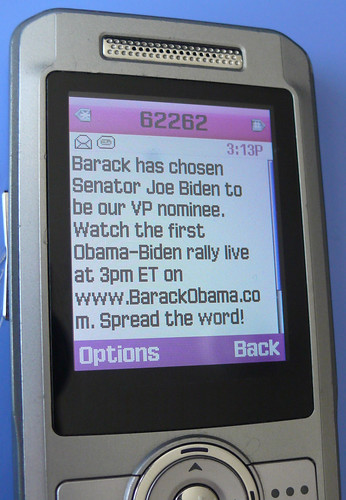
At 1:53a on Saturday morning as I was putting shoes on and getting ready to leave a friend's house, I got the text:
Obama Text


There has been some criticism that it was a sham, that people didn't find out before the media and were disappointed, that it was a waste of time and anticipation. I strongly disagree.

First of all, anybody who thought that a large-scale SMS like this could be pulled off without a hitch is foolish. Different carriers have different delays. I frequently get text messages 4 hours after they are originally sent to me. That's just how it is right now. The Obama text was deployed just after 3am EST, midnight here in San Francisco. I didn't get it until 1:53a my time, just before last call. And not only were the networks flooded with the messages coming out from the Obama campaign, they were flooded with people immediately forwarding the message onto their friends and subsequent SMS exchanges. I sent and received at least 20 text messages within a half hour of receiving my text. I do think it's a bummer that some people never got the SMS but I hardly think that's grounds to call it a scam.

Second, while the New York Times and other major papers put the news online immediately, thus before many people had received their texts, the announcement was absent from some of the print editions of major papers, including the New York Times and the Wall Street Journal. Why? Because the text was sent after most of the Saturday editions had long been put to bed and were peeling off the presses. Sending this kind of information after the major papers have gone to press has traditionally been considered political suicide, but the Obama campaign knew what they were doing. The information was disseminated digitally, not via newsstands. Some critics think the 3am timing was a last dig on Hillary, but I think it was less a dig and more recognizing the importance of that 3am response.

According to some complaints from people who never received the text, I was lucky to get mine at all. But I can honestly say that I've never been so excited to receive a text message. I was nowhere near a computer when the text came, and hadn't received any tips from friends elsewhere in the country, so it was nice to be able to go out, have fun, and receive news like this via 2am SMS. My only real disappointment is that the text didn't start with "Hi, this is Barry!"

It's important to keep in mind that this was an experiment and it was not executed perfectly, but it does serve as a proof of concept. But what other politician has tried something like this on such a large scale? It was a great way for the Obama campaign to harvest phone numbers and build quite a buzz, but it was also a bold use of mobile technology—and great practice for November. As a friend put it, "The blogosphere can't quite yet eclipse the major news media. Heck, twitterverse was convinced it was bloomberg before the runup that day."

Of course, Biden's support of the DMCA and his friendliness with the RIAA are whole different issues...

— Jess Hemerly, August 2008

Thursday, April 3, 2008

Songbird: Future of the Free Media Web [IFTF]

Institute for the Future, April 4, 2008 [Link]

Two things we are beginning to talk about regularly at IFTF are open source and free media. Songbird, a media player in development by San Francisco's Pioneers of the Inevitable, harnesses both of these things.

Two things we are beginning to talk about regularly at IFTF are open source and free media. Songbird, a media player in development by San Francisco's Pioneers of the Inevitable, harnesses both of these things. Songbird recently released its 0.5 version, and while not quite ready for consumers yet, it is building a strong community of developers and users.

From their website:
Play music. Play the Web.

Songbird is a desktop media player mashed-up with the Web. Songbird is committed to playing the music you want, from the sites you want, on the devices you want, challenging the conventions of discovery, purchase, consumption and organization of music on the Internet.

Songbird is a player and a platform. Like Firefox, Songbird is an open source, Open Web project built on the Mozilla platform. Songbird provides a public playground for Web media mash-ups by providing developers with both desktop and Web APIs, developer resources and fostering Open Web media standards, to wit, an Open Media Web.

Built on Mozilla's XUL, Songbird is both a media player and web browser. By mashing up these applications, Songbird features a few interesting innovations. When surfing to an MP3 blog page, Songbird automatically sniffs out any media on the page and pops up a playlist of those tracks. Instead of having to download or play in a separate tab to test out the track, users can double click the song in the pop-up playlist to sample it. If you like it, you can simply click "Download" to save the song to your library. Once in your library, you can drag the track to a playlist or transfer it to a portable device. Songbird also lets you view your library in tag clouds and filter your library by metadata categories iTunes doesn't support.


Since it's open source, Songbird leverages an add-on platform for developers to create their own extensions and themes called "Feathers." There are already a good number of add-ons for Songbird, including a few that contextualize your music listening with metadata from all over the Web. My favorite thus far is an eMusic plugin that allows you to surf and download from eMusic directly through the player, bypassing eMusic's downloader, making the overall user experience much friendlier for eMusic users. Developers have also created device support for nearly every portable music device under the sun, including the iPod.


For audiophiles who scour the Internet for free media, Songbird is a great all-inclusive tool—a window to an Internet teeming with free media. The Internet provides the content, but Songbird helps your harvest, use, and make sense of it. As the community grows, it will be interesting to see what extensions people create and what kind of user base Songbird will foster. This recent release has brought them some good press, including MacLife and Wired. For more detailed information, check out the Songbird blog.

— Jess Hemerly,

Saturday, March 1, 2008

Citay: Bridging the Gap Between Joan Baez and Judas Priest [The Owl Mag]

The Owl Mag, March 2008 [Link]

Former Piano Magic drummer Ezra Feinberg and Tim Green of the Fucking Champs never really formed the San Francisco–based, psychedelic folk/rock band Citay, at least not in an earnest "We're starting a band!" kind of way. The two met in New York when Green flew out to record Feinberg's band at the time, Feast, and hit it off instantly thanks in part to their "alarmingly similar" musical tastes and approaches. "It's uncannily specific: we like the same specific parts of the same specific songs," muses Feinberg. "We literally found ourselves spontaneously air guitaring to the same sections of the same Heart songs. It was love."

Curious about life on the west coast and eager to get out of—and away from—Brooklyn, the Cambridge, Massachusetts native packed up and headed for San Francisco in 2004. He crashed at Green's studio, Louder Studios, for a month until finding an apartment in the city. Once settled, he began making demos with an electric guitar, an acoustic guitar, his Casio keyboard, and a computer. "When I felt like I had some good materials, I went to Tim's and would re-record it from scratch at his studio, then he'd kind of add his own stuff on top of it," says Feinberg. "The skeletons of the songs I worked out on my own, and a lot of the embellishments and decorations—which is sort of what makes a lot of it—are stuff that I did with Tim in his studio."

Their collaborative efforts secured Citay a deal with Important Records, who released the self-titled first album in 2006. Feinberg never envisioned it as a live act when he started making demos in his apartment, but with the deal signed and a tour inevitable, he faced the daunting task of finding all of the instrumentalists needed to recreate Citay's multi-instrumental sound on stage. After a determined effort and a "revolving door" period, Feinberg pulled together a lineup that has remained consistent for the last two years. Now, Citay is ready to embark on their second national tour. They're also headed for their second appearance at SXSW and have even caught the attention of NPR: "Eye on the Dollar" from Little Kingdom was NPR Music's "Song of the Day" on February 26.

Citay's vocals are a little Spiritualized, and the influence of everything from Yes to The Zombies to Sonic Youth poke through the band's melting instrumental melodies. As Feinberg puts it, Citay's sound is "pop music that tries to bridge the gap between 'Diamonds and Rust' by Joan Baez, and 'Diamonds and Rust by Judas Priest." Last year's Little Kingdom (Dead Oceans), pays homage to 70s psychedelia with a fresh interpretation of old trippy sounds. And while Citay was exclusively created and recorded by Feinberg and Green (with a little help from Green's Champs bandmate, Tim Soete), Little Kingdom features all members of the band at least somewhere on the album. "I think Little Kingdom is officially a better record than the first record, but I can still hear the breeziness of the first record," he reflects. "It has an ease that maybe I only hear because I made it, but it is an ease that I appreciate and long for."

Because Citay's music is fundamentally Feinberg's vision, the creative process doesn't operate like other similar-sounding, multi-instrumental bands that work as collectives. "I think of a collective more as a democratic thing, where Citay is more of a fascist state," says Feinberg. "I'm a friendly dictator." No doubt Feinberg took a few cues from another friendly dictator, Piano Magic's Glen Johnson. Piano Magic is known for its ever-changing lineup, with Johnson remaining the only constant member of the band. At the age of 20, Feinberg spent six months playing with Piano Magic and found in Johnson a musical mentor. "It was an inspiring thing to be a part of," he says. "Musically, Glen is coming from a totally different place than me but I think that he is always working, is always a part of a community and he's obsessed with music—that's what gets him up in the morning."

Even the band's name, inspired by a mix tape Feinberg made, reflects his creative control. The mix consisted entirely of songs where the vocalists sing "SIH-tay" instead of pronouncing city the normal way—think Stevie Wonder, Journey, Foghat, etc. "When I named it 'Citay,' I never thought it would go anywhere," admits Feinberg. "Had I known that it was going to reach anyone beyond my friends, I may not have named it that, but I don't regret naming my band Citay. That's the name, love it or leave it."

As for his adopted home, Feinberg finds it easy to fit into the San Francisco music community, especially compared to fragmented music communities in vast cities like New York and London. In addition to bands like Vetiver and Six Organs of Admittance (they've toured with both), Feinberg is a fan of all of his bandmates' other projects, which include 3 Leafs, The Dry Spells, Meridians, and, of course, The Fucking Champs. He tells me, "The music scene here is really special because it's so diverse and people really know what's going on in the world of music of all kinds, and yet it manages to be small and kind of intimate and cozy."

For now, the band looks forward to their upcoming national tour, which will bring them to bigger venues and more cities than their last. Citay's future will almost certainly include a third album, but Feinberg doesn't know when or exactly how it will be made. "I always have ideas floating around, but I'm not like one of these songwriters that has 5,000 songs written and recorded and can sort of select forever," confesses Feinberg. "I write and record as I go and when a record comes out, that's everything I have from that time."

Citay will open for Oakland favorites Heavenly States at the latter's album release show at the Independent on 3/7.

For more information on Citay visit http://www.myspace.com/citay07

—Jess Hemerly, 2008

Sunday, September 23, 2007

IDFTF: Institute for Doing the Future [IFTF]

Institute for the Future, September 23, 2007 [Link]

David Pescovitz, Mike Love and I joined Bob Johansen at SQUID Labs today, where Bob talked about IFTF, our foresight/insight/action mantra, and his book, Get There Early. SQUID Labs is a unique breeding ground for innovation with a social bent.

David Pescovitz, Mike Love and I joined Bob Johansen at SQUID Labs today, where Bob talked about IFTF, our foresight/insight/action mantra, and his book, Get There Early. SQUID Labs is a unique breeding ground for innovation with a social bent. From their website:

At SQUID Labs we develop breakthrough technologies and find solutions to unique engineering problems. Our exceptional team has expertise in a wide range of technical fields: from chip design and electronics to robotics, materials, embedded systems and manufacturing. We have created a highly dynamic and creative work environment which helps to inspire our consulting and contract research efforts.

In the course of our work (and play) we have developed novel and diverse technologies for a wide range of applications including printed electronics, lens molding, and high performance kites.

SQUID Labs is characterized by our multidisciplinary skill set and our ability to combine those diverse skills to create novel solutions.

"We're not a think tank, we're a do tank"


While we at IFTF spend most of our time thinking about the future, the guys over at SQUID Labs are doing the future. IFTF is about foresight; SQUID Labs is about action. As one of the SQUID guys said today, you might think of them as the Institute for Doing the Future.

A great example of something to come out of their work is a SQUID spinoff company, Potenco. SQUID Labs co-founder Colin Bulthaup is the company's CEO. Their product is a pull-cord generator, intended for use with the XO Laptop (One Laptop Per Child Project). Check out their website for the specs. It's a great solution to the problem of providing electricity to places that lack an energy infrastructure.

One of the most interesting things that came out of today was an understanding of how the two organizations could really work together. We would be able to provide an idea of what areas or technology or engineering will present problems or dilemmas potentially needing solutions, and the SQUID Labs team could take cues from our forecasts to start working on these solutions before the problems really become problems.

They also happen to have a very cool location, in the control tower on the Alameda Naval Air Station.

— Jess Hemerly, September 2007

Wednesday, June 20, 2007

Real World GarageBand [MacTribe]

MacTribe, June 2007

DIY finds some help.

Studio time, marketing, promotion, pressing, packaging, distribution... all of these things require money and inside connections for up-and-coming musicians. But as technology advances and the phrase "famous on the Internet" begins to translate to dollars, do-it-yourself (DIY) musicians find more ways to work effectively outside of the music industry's traditional system. Enter Apple's GarageBand. This application has become a creative catalyst for everyone from the average tinkerer to the signed artist. From full album production to long-distance collaboration to sketching new songs on the road, Apple's music editing application has given new meaning to the term "garage band," allowing the company to further entrench itself in the music industry.

A perfect example of the DIY band, Los Angeles-based Bastard Fairies put their entire album together in one week using GarageBand. The band picked up Fisher Price toys from thrift stores to add texture to the music, threw in some socially conscious lyrics, stitched everything together in GarageBand, and offer the album as a free download. Band member Robin Davey loves the simplicity of the program and believes it served as an enabler for the band. "It's the quickest way to get your ideas down," he says. "Once you actually open it up and realize how quickly you can build a track it definitely enables that creative process and takes away the need for expensive studios and things like that. Everything is there in one package."

The Fairies advertised their free album on YouTube with videos assembled in Final Cut Pro. One of the videos, a "commercial" for the album, featured an eight-year old girl talking about the perils of religion and the failures of an educational system that pushes religion instead of empathy. The video quickly became popular on YouTube, and criticism from Fox News pundit Bill O'Reilly unexpectedly boosted the DIY band's exposure. "People grabbed hold of [the video] and, because it was tagged at the end with the Bastard Fairies website, they discovered the album there," says Davey. "That led to it being most subscribed on YouTube."

Despite the popularity, the Bastard Fairies chose to keep with the DIY spirit and not profit off of the album in the wake of their celebrity status. They will offer a special version with five extra tracks and a bonus DVD for purchase, but the original album will always be free for download. "Because the album was done on a budget of about $10 there's no reason why we can't give it away," he says. "There's no one to tell us that we can't and also if we do that, people are going to download it. We're going to generate fans." Thanks to Apple's technology, they were able to successfully retain full control over the entire process, from recording to distribution and promotion.

Like cassette culture of the '80s, GarageBand is a way for new artists to record a demo, but unlike the '80s cassette culture, social networking sites like MySpace and YouTube allow artists to self-release and build a fan base before finding their way to the airwaves. An existing fan base gives them an advantage when it's time to shop for a label. "We're in this stage where you can do so much more by yourself and I think it's very empowering to be able to record yourself," says singer/songwriter Ari Heist. "As a musician, it's such a key thing because otherwise you'd be spending a whole lot of money to get other people to do it for you." Heist produced and recorded his 2006 EP, "The Green Room Sessions," in his Brooklyn apartment. He played every single instrument on the album—a feat in itself—and assembled the pieces with GarageBand. Unlike the Fairies, however, Heist has been signed to a major label, Columbia, for a few years. "I'm not the first to do this, but I'm really excited about it," he says, taking a break after performing at SXSW. "I use it all the time."

Even artists who don't record entire albums with the software find it a useful part of the creative process. Singer/songwriter Jann Klose uses GarageBand in conjunction with ProTools and Logic to collaborate on songs with his keyboardist. "When there’s a new song idea I usually dump it right into GarageBand," he says. Unlike Logic and Pro Tools, which consist of folders within a file, GarageBand creates a single all-inclusive file, making it easier for artists at different locations to collaborate. And since GarageBand files can be opened in Logic without needing conversion, Jann will open it up there in order to generate and print the arrangements for other parts of the ensemble. "My keyboardist and I go back and forth with the file and we can work on adding strings in MIDI thanks to the new MIDI capability in GarageBand."

GarageBand's ease of use combined with the portability of Mac laptops make it a great application for capturing ideas whenever and wherever they happen. For a touring musician, this is often the bus, the bar, or backstage. Adam Merrin of The 88 depended on GarageBand for the drums on his solo album, but his band, recently featured on the popular television show "The OC," also uses the application when they're on tour. "I remember being on the road and using it to record ideas while we were in the car," he says. "We can just open up the laptop and start creating melody ideas on it."

Apple's recent forays into music have proven incredibly successfully, and GarageBand is no exception. The program has already become popular with average Mac users who just like to geek out and play. Many companies also offer loops for users to download and manipulate. Communities on the Internet like MacJams and iCompositions provide forums for fans of the GarageBand to upload loops and tracks and share them with other members of the community. Nine Inch Nails frontman Trent Reznor has even gotten into the GarageBand spirit. He periodically releases tracks as GarageBand files and encourages user remixes. Since GarageBand is so easy to use, theoretically anyone can make music.

But could GarageBand make it too easy for anyone with a Mac and a mouse to have delusions of rock star grandeur? "No," says Adam Merrin. "The song is still the most important thing. It’s very easy and inexpensive for people to put out their own records but the best stuff is always well written." Robin Davey agrees there's no hope without some idea of what a song is all about. "That's the essential thing: the song that you start with," he says. "Without that you're not going to get anywhere."

As a viable option to expensive studio time, GarageBand will help good do-it-yourself artists emerge on little to no budgets. But unlike "American Idol," which offers the hope of three minutes of fame even if you sing like a jackal, some semblance of musical talent and a sense of creativity is a prerequisite for getting anywhere with the music you create, even in GarageBand. Still, the consensus is that it's worth digging into and exploring what GarageBand has to offer. "I couldn’t recommend it more," says Merrin. "The fact that it comes installed with all the Mac computers is the coolest thing of all." Robin Davey sees it as part of a trend in technology making artists more self-reliant. "I think that the more and more computers evolve, the easier it gets for artists to put their creativity down."

But while GarageBand won't replace the studio any time soon its rise is certainly not good news for everyone. Heist believes an easy and affordable program like GarageBand negatively impacts smaller independent studios who rely on the business of small up-and-coming bands. "You see a lot of studios going out of business, a lot of studios that were once very sought-after and had really nice stuff to offer, but you can create something that's as good or almost as good in your own home," he says. "It's a no brainer. You won't want to spend that much money everyday to go to a studio."

Jan Klose sees its accessibility as nothing but positive. "If you’re creative there’s a lot of things you can do with it right off the bat. The main thing is that you don’t have to spend a lot of money to get it since it comes with iLife and new Macs. The fact that it’s so fun and easy to use makes it an obvious choice."

Time will tell whether or not GarageBand will have a lasting impact on the music industry, but it's clear for now that Apple fortifies its place in the music scene with this DIY-inspired application. Combined with the ability to build a following on the Internet, GarageBand has the potential to revolutionize an entire segment of the digital music industry.

— Jess Hemerly, 2007

Sunday, April 1, 2007

Low: Delight Us With Silence [Chord]

Chord [site is down], Issue 42, April 2007

The band's dirge-like percussion, grinding, minimal guitars, long harmonic vocal phrases, and emotional lyrics resulted in a sound so different that it prompted a friend of Sparhawk to coin the term that has followed them throughout their career. "We played our first shows here in Duluth and this friend of ours who worked in a record store was always joking around about the intricacies of the music scene and he said ‘I got it! You should call it Slowcore!’" Sparhawk reminisces.

When Alan Sparhawk started Low, he had no idea that nearly fourteen years later they would still be making records. "We were just kind of fiddling around and we had no ambitions at all," says the frontman. "The next thought was that we’d do a show and see what kind of adverse reaction we’d get out of people. It was very much dictated that we’re gonna play really slow music that’s barely there and see how little we can get away with." But they began to realize the possibilities of the style and it caught on with fans. Now, on the brink of their fourteenth year of playing haunting, minimalist music with his wife Mimi Parker, they're set to release a new album on SubPop, Drums and Guns.

The band's dirge-like percussion, grinding, minimal guitars, long harmonic vocal phrases, and emotional lyrics resulted in a sound so different that it prompted a friend of Sparhawk to coin the term that has followed them throughout their career. "We played our first shows here in Duluth and this friend of ours who worked in a record store was always joking around about the intricacies of the music scene and he said ‘I got it! You should call it Slowcore!’" Sparhawk reminisces. "It was a total joke and I think I mentioned it at one of our interviews." The tag stuck. They don't hate it but they do find it amusing. "You gotta have those tags I guess. I think that there are worse things to be called."

Their style has deeper roots than trying to shake things up in Duluth. Like many musicians, Sparhawk learned more about music in church than anywhere else. "Anyone who’s grown up going to church regularly with their family ends up singing those hymns and for some kids that’s the only singing you do throughout the week except for maybe some singing in school during the week." Alan was raised as a Mormon and his father, a jazz musician, often enlisted him up to sing for the congregation. "We’d loathe doing it but I look back and I realize that here were some semi-sophisticated things we learned from doing that," he says. "Harmony, breathing, holding notes, enunciation… those songs move slowly and there’s very long phrasing." That style has come to define Low's vocals.

The trio teamed up again with the producer of their 2005 rock-and-reverb infused album, The Great Destroyer, but Drums and Guns is nothing like their last outing with the David Friddman, the producer known as "the Fifth Flaming Lip." "David is a good producer," says Sparhawk. "He lets the band breathe and helps you push yourself. There was a lot of conversation homework, a lot of phone calls before we went in to record, just kind of me rambling and mumbling about whatever my concerns were and by the time we got to the studio he at least had me figured out a little bit and help us get on the right track and find what we were looking for."

Low is back from their adventure in rock with the new album, but this time they took a different approach in the studio than they have in the past. "You can hear drum machines and loops and there’s more dabbling in mechanical things," says Sparhawk. "We kind of assembled the record like a hip hop record." It's a departure from their usual method of sitting down in the studio, playing the songs as if playing for an audience, and fleshing them out as they go along. "After all these years I just sort of know all the patterns we’d fall into if we just do that so we decided to not do it that way," he says.

Sparhawk and Parker will tour this spring in support of the new album with current bassist Matt Livingston (also the bassist in a Sparhawk side project, Retribution Gospel Choir), but with one of their two children now in school, the future calls for changes. Sparhawk admits, "It’s getting more and more difficult to work out scheduling for touring." Regardless of whether or not they decide to really settle down, they will never give up music altogether. "It seems like music is just part of us," he says. "It’s kind of what our family has become and I think we’ll always have something that we’re doing in that realm."

For now, Low fans can relish Drums and Guns as a study of what has kept this band unique throughout the years. "There’s definitely a couple songs that, as far as recordings and stuff," says Sparhawk, "I definitely think are the strongest things that we've done."

— Jess Hemerly, April 2007

Saturday, February 3, 2007

Readers Write: Can Apple and the Tech Industry Be 'Green'? [AlterNet]

AlterNet, February 3, 2007 [Link]
Response to "Apple Computers: Fun For You, Toxic for the Environment", by AlterNet staff, with my response at the end.

Our readers questioned whether Apple deserved its low environmental rating from Greenpeace and what can be done to green the tech industry.

These days technology is so much a part of our lives that we sometimes forget to think about where it comes from -- and importantly, where it goes when we are done with it. This week we published a story by Jess Hemerly about Apple computers, which was recently ranked by Greenpeace at the bottom of the list of eco-friendly tech companies.

The story elicited a number of passionate responses from readers, some of whom felt the folks at Mac were unfairly targeted considering the rest of the industry's track record.

Greenman wrote:
Apple is certainly no worse than its peers, and is better than some, regarding the environment. Seriously, the idea that any computer is good for the environment is pretty crazy. There's nine times as many PC's as there are Apples in the trash heaps of the world, and there's not a nickel's worth of difference between an Apple carcass and a Dell carcass, I'd wager, in terms of harm to the environment.

As other posters have pointed out, what is needed for electronics and computers -- especially -- and for all products in general, is a pricing system that would include "cradle to grave" provisions for mitigating harm to the environment for the entire life of the product. Everything would quickly become of much higher quality, would last longer, and would be more expensive, too. That's the kind of carrot-and-stick regulation that government could impose, but doesn't for all the grubby reasons we are all too familiar with these days.

Other people also mentioned the issue of durability and thought that Apple's lifespan should be taken into consideration -- arguing that people go through their PCs quicker than their Macs.

In her article, Hemerly compared Apple's environmental policy to that of Dell, citing Dell's recent commitments to providing free recycling to their customers worldwide and their recent "Plant a Tree for Me" campaign that allows consumers to pay an extra $2 for their computer purchase to go towards reforestation.

But one reader said that that Dell's efforts were more symbolism than actually productive environmental efforts. Thoughtcriminal wrote:
Just because Dell allows you to make a $2 donation to a 'plant a tree campaign..." -- that makes them a responsible greenwashed company? What's needed is a generalized government-regulated e-waste recycling industry that provides safe working conditions; you could simply place a small tax on all computer and electronics gear sold in the U.S. to help fund such a program.

I mean, go down to your nursery, buy some trees, and plant them yourself -- your $2 feel-good donation to Dell is nothing but green marketing (that you get to pay for!)

Several other readers also thought that since Apple was abiding by the laws, they shouldn't be singled out for punishment, but did suggest that this is a problem that should be addressed with federal regulation.

TheGrunger wrote:
Dell may be marginally better than Apple -- but neither one is going to bend over backwards to do what is right if it cuts too far into their bottom line.

While I think it is valuable to point out things like this, unless they are actually breaking the law I don't see any value in singling out Apple or any other company. We cannot expect corporations to do the right thing (in any situation, environmental or otherwise) if there are not strict regulations in place to punish them harshly for doing the wrong thing.

The problem is the entire corporate system and the weak regulatory laws of our government -- that is where we should focus our efforts. That is the only way to force companies like Apple to pay attention.

While some people felt that it was the government's job to legislate change, others found the article helpful in letting consumers know that they can begin demanding that Apple and other companies, start doing more to protect the environment.

Ghoulman, a Mac user, wrote: "I think all the right points are put out in this article. Computers, and electronics in general, are a dirty little landfill secret ... I'm glad someone is upping the environmental anti."

Likewise LarryGroff wrote:
I am also a long time Mac and PC user who is very concerned about the environmental impact of my computers. I would agree with those who take Jess Hemerly to task for not investigating thoroughly enough about Apple's environmental record and the superficiality and grandstanding of Greenpeace's Green my Apple campaign.

However, Apple is a large corporation whose business goals are far ahead of any other concern, to think otherwise is naive. Apple is not a movement regardless of how we might wish it so. But it is good that Apple is getting the green lights blasted on its facade as it may prod them to indeed move ahead and make their environmental decisions even more carefully and boldly if they fear that their reputation and popularity are at risk.


Hemerly herself, responded to our readers' comments and asked that we see the bigger picture intended in her piece.

She wrote:

First, I can assure you that I did very thorough research that included conversations with both Apple and Greenpeace. The Apple spokesperson I talked to was very friendly but there was little room for discussion because that's simply how the company operates. She walked me through their site and I read everything. I wrote my piece based on the information I was provided. If Steve Jobs wants to sit down with me and talk about environmental policy and the Greenpeace campaign, I will jump at the chance. As it stands, that hasn't been presented as an option. The spokesperson from Apple directed me to the Roughly Drafted site, which is a great spin on things but it is, like my own piece, one writer's conclusions. As the reader, you are your own filter and it's up to you to choose what you want to accept or dismiss.

I do not envision Steve Jobs as some evil king looking down on a polluted world from his gleaming white polymer spire. I do envision Apple as a company of innovation and one that has in its own words asked people to "Think Different." And now that Greenpeace has decided to turn it around and ask them to do the same, everyone is up in arms. Is it because Greenpeace is the organization doing the asking? Greenpeace is not hurting Apple. Apple continues to gain market share and turn in record profits as a result of the Halo Effect the iPod spawned. Greenpeace is simply asking a company that champions innovation to pitch in and be as innovative when it comes to the environment.

Michael Dell and his company were used in this piece to contrast Apple's tight-lipped attitude toward environmental policy. Dell is not perfect and neither is Apple, or Nokia, or Fujitsu, or any of the companies who make the devices we take for granted everyday. They all have serious faults and questionable practices when it comes to various aspects of business. But is Dell bringing green ideas to the table? Absolutely. And a table full of ideas is where change begins.

Yes, better regulations should exist, and so should a litany of regulations that require all companies, technology and otherwise, to do more to help the environment. But given the political climate of the United States right now, it's unlikely that any progress will be made here anytime soon. Thus, Greenpeace has been forced to turn its efforts toward something that can produce results. Have we become so jaded that we are willing to give any company a bye just because it's "business as usual"?

Of course, Apple is not the only company contributing to the e-waste mess. But they are the only company that makes beautiful machines that people are willing to shell out extra money to carry with them for reasons ranging from cool factor to basic operation. Is it really so crazy to ask them to make their beautiful machines cleaner than the rest, to really go out and set the standard? They are not the "little guy" anymore. They're a serious contender and that becomes more evident every time they gain a percentage of the PC market share.

You ask me, "Why Apple?" I ask you, "Why NOT Apple?"

In the end, there is no doubt that the technology we use is toxic -- and that more can and should be done to ensure that it is made and disposed of as safely as possible. It is always easier to point to someone else to take the responsibility for making that happen -- but whether we want the government to regulate it or companies to prioritize it -- it is still up to us to make that happen.

Monday, January 8, 2007

MySpace Virtual Demo [MacTribe]

MacTribe, January 2007 [Link Part 1 & Part 2], also appeared in MacTribe's first print edition.

How MySpace Connects Artists, Labels, and Fans

Teenagers adore it. Young adults use it to pass the time at lame desk jobs and track down people from their past. Predators use it to zero in on potential victims. Parents fear it more than any parent feared the Beatles and Elvis's gyrating hips combined, and other people just think it's a stupid waste of time and energy. So what could possibly make MySpace useful beyond worldwide Internet distraction?

Music, that's what.

Before the dawn of the Internet age, when everybody suddenly fancied themselves an expert in web site design, musicians looking to promote their work had to do so through analog means: demo tapes, flyers, performances at artist showcases, etc. And just because they got a gig or found an A&R exec who’d bite doesn’t mean they’d have the one thing that can keep a musician’s career going for a long time: fans.

The digital revolution made it easy to upload tracks to a server and put them on the Internet, where everybody has access to them. But band web pages required at least rudimentary HTML skills, and not everyone broke down and bought a copy of HTML for Dummies. Now, anybody with a few tracks, a computer, and an Internet connection can create a self-promotion music page thanks to the controversial juggernaut of a social networking site, MySpace.

A few months ago, I received a MySpace message from Karl Miles, a former high school classmate who I’ve been out of touch with for 7 years, asking me to go to his MySpace Music page and check out his tracks. He's starting a career as a solo folk artist and found me through the magic of MySpace. He wanted to know what I thought of his music so I went to his profile and listened to his tracks, played through the built-in mini player. Since he made them available for free I was also able to download them, save them to my computer, and play them for my friends.

Karl admits that part of the attraction to MySpace was its ease of use, having put off setting up a "real" site for far too long. And he doesn't subscribe to the delusion that MySpace will make him famous. "I find an open mic will generate more attention," he says. "It is more likely a person will hear about me some where else and check if I'm on MySpace." He certainly doesn't believe that MySpace is an easy way out of a musician's traditional struggle to be heard. "You still have to do leg work, play gigs," he says. "If you get a buzz outside MySpace maybe you can get one on MySpace. But I don't think MySpace will create one for you on its own."

Ezra Caraeff, owner of Portland-based indie label Slowdance Records, sees many bands are not as realistic as Miles. Instead they believe that a MySpace page and 400,000 friends is a quick ticket to Mick Jagger status. "I think a lot of bands think friends equal sales," he explains. "But those are the same bands who think emailing me to 'check them out' or 'you should sign us, we RoCk' [sic] is a good idea as well."

The problem with MySpace for many hopeful musicians is that the "adding friends" feature creates a false sense of audience, and with that false sense comes an inflated perception of fame. There are actually programs that crawl MySpace on a band’s behalf and add friends at random, an act equivalent to email spamming. "Since it's so lawless," says Caraeff, "it's a chance for these unknown bands to be on an even plane with known artists. Like, we don't have a record or play shows, but we have as many friends as Hoobastank." Caraeff also worries that the meaning of the word “friend” will be forever corrupted by the MySpace “friend” system.

Yet despite this grand delusion factor, Ezra's label insists that all of their artists have MySpace pages, most of which are maintained by interns. Even his label itself has a page, and Slowdance has used the bulletin feature to reach bands' audiences—although Ezra still thinks email blasts are more direct and consequently much more effective. A blog post on the profile—which touts the label as the "Best. Label. Ever."—begs musicians not to spam them with requests to listen to their tracks.

As the head of a label, Caraeff sees the proliferation of bands with little talent but a lot of friends as just another stage in the evolution of the music industry. "My brother used to work at Capitol Records and I remember going there when I was in like 10th grade and seeing crates of demos in this dumpster," he reminisces. "It's a very sobering thing. MySpace reminds me of that on a daily basis… so much delusion."

But not every band that’s active on MySpace is mired in delusion. One band that has found success via the Internet is Saosin, a post-hardcore band who got their start by posting tracks to a variety of Internet music forums. Their tracks caught on, and their first show was jammed with kids clamoring to see the band they'd heard on the Internet. They now have a deal Capitol Records and just finished their third Warped Tour.

Saosin maintains a MySpace page. In an interview with bassist Chris Sorensen he made it clear that the guys in the band actually use it. Part of the fun for Chris is the ability to listen to a band’s tracks on one page and then “go check out some hot babe’s page.” The band’s page boasts over 178,000 friends and actual band members answer messages.

Another up-and-coming band that actively uses MySpace is Holiday and the Adventure Pop Collective, an Americana group from the San Diego area that tours widely all over California. Recently nominated for the title of Best American Band for the San Diego Music Awards, band member Louis Caverly says they use it for at least an hour every day when they’re not on the road. “MySpace is a community and for any community to work you have to talk to the people,” says Caverly. “It is pretty rad to talk directly with folks, be it potential fans or possibly a personal hero that you stumble upon.”

At first it just seemed like an easy place to upload tracks but Caverly now believes that it is a great tool to have in the arsenal as they build their career. They will solicit potential fans but not by using a “friend adder.” Instead, they take the time to surf the site for people with tastes that match their style and for bands that play a similar kind of music. For them, it’s really about logging on and making it work. “MySpace will help us to increase our audience because if you use it, it works.”

Shawn Hatfield, an experimental electronic musician in San Francisco, has a similar philosophy when it comes to reaching out through MySpace. "I already had a personal page and figured it would be a good place to give my fans access to information on upcoming projects and also a way for them to feel like they've had a personal connection with me that goes beyond just owning the CD or record," he says. Hatfield has had offers to play gigs overseas through MySpace and believes that MySpace has the potential to help him gain enough attention to score larger gigs.

But how realistic is it that the music industry sees these band pages as anything more than must-have novelties for their artists? Well, if an artist catches the eye of an active MySpace user who happens to work in A&R (artist and repertoire, in case you have always wondered what it stood for), it’s very realistic. And such A&R reps do exist. Tony Kiewel, head of A&R for indie label SubPop, is one active user who believes that MySpace is something more than just a project for interns or a collective unheard cry for attention. "I definitely look at it to hear new stuff both as a fan of music and as an A&R guy," he says. "If I like a band I'll look at their page and often times end up listening to their friends’ bands that they have in the top 10 or whatever that little list is." So there's no algorithm that converts MySpace friends to record sales but who a musician is connected to and how may lead to an important discovery by the right person.

Kiewell also relies on the site as a research tool and a quick way to zero in on what people are listening to. "You can't Google 'The Books' and find anything helpful about the band without some serious digging," Kiewell explains. “If I go to MySpace and do a band name search I can find them in seconds." And it's not just a band bio that you'll find; it’s an interactive page full of information. "I can hear them. I can see where they're from. I can see who they're fans of," says Kiewell.

And for musicians, the ability to check out who other musicians are into makes it an extremely useful networking tool. Solo artist Lia Rose experienced this first hand when one of her favorite indie musicians, Damien Jurado, left a comment on her MySpace music page. “I could hardly believe it, and of course returned the sentiment with a comment on his page,” she says. That comment led to an interesting chain of events for Rose. A member of a band in Holland, Winterbirds, found Rose’s comment on Jurado’s page and they added each other as friends. “After about a year of corresponding,” she tells me, “he gives me an internet music challenge by sending a song with just guitar and inviting me to write lyrics and melody and send some vocals back.” This correspondence turned into a project called Weatherkingdom that, naturally, has its own MySpace page too.

MySpace is more than just another venue for Internet voyeurism—it is actually a fantastic tool for labels, fans, and artists alike. “The real take-a-ways include finding other artists to play shows with, Internet radio stations to spin our songs, industry contacts, far away friends and folks that can help our career grow,” believes Louis Caverly. And the recent announcement that MySpace has teamed up with Snocap to allow artists to sell their tracks directly through MySpace pages will only make things more interesting. “I think it will be the great equalizer for those bands that hoard ‘friends,’” Caraeff contends. “They will soon find out the sobering results of 40,000 friends and $6.00 in total downloads.”

But will the day come when a label “discovers” a band through their MySpace page? "It's totally possible," Kiewell of SubPop predicts. "It hasn't happened yet but I bet it will soon.”

— Jess Hemerly 2007

Wednesday, November 1, 2006

The Dears: Critics of Cool [Chord]

Chord [site currently down], Issue 40, November 2006

Gang of Losers is about the nerds, the individuals, the ones who are only uncool because they don't follow the herd. Aptly titled, it captures the experience of feeling like a loser, something even the cool kids can grasp.

If you ask The Dears' frontman Murray Lightburn what he thinks about the Canadian indie scene, he'll answer, "Why wasn't anyone asking about it ten years ago?" Maybe it's because a large chunk of the audience following today's surge of Canadian imports was still playing on jungle gyms ten years ago. "Canada is just a place," says Lightburn, but he adds, "The Dears have Canadian passports, for which we are truly grateful." It's no wonder, though, that Lightburn brushes the question off. His band is an aberration from saccharin-sweet pop embraced by today's popular Canadian indie bands. The Dears craft a unique sound from contemplative and dark lyrics layered over rich, orchestral compositions—and happen to hail from Montreal.

The sextet has also been at it for a lot longer than some of the other Canadian bands now popular in the United States and worldwide, but The Dears have remained largely under the radar. The core members of the band—Muray Lightburn, Natalia Yanchak, George Donoso, and Martin Pelland—have been working together for six years, when it first started as a sort of singer/songwriter vehicle for Lightburn. After a series of additional instrumentalists and guitarists who didn't quite fit, the complete lineup, which includes Valerie Jodoin-Keaton on keyboard and flute and Patrick Krief on guitar, has been together for two years. "The lineup we have now kind of feels like a 'forever' line up, very thick and thin," says Lightburn. "This lineup has been through the most shit together and even our road crew is like family. We would probably kill for each other."

While The Dears have been compared to Britpop bands like Blur and their frontman himself to Morrissey, the similarity is far from uncanny. He's not trying to emulate. He has taken something away from everything he's listened to, even the string and horn arrangements of Isaac Hayes tracks. "I think that in my case, music chose me—us, for that matter," says Lightburn. "Sometimes it's a blessing; other times, a curse." Like many musicians, Lightburn's relationship with music started at an early age. "The first song I remember barely singing was 'Oh Little Town of Bethlehem,'" he reminisces. "Apparently I made people cry. I was, like, five."

The impact he had on that church congregation may have been accidental, but the impact of his work today is not. Lightburn looked to achieve something that feels much more organic than the usual studio album that results from tweaking and splicing takes. Recorded in Lightburn's home, Gang of Losers is much more bare than No Cities Left, their acclaimed 2004 release, and 2000's End of a Hollywood Bedtime Story. Every song on the album is a single, continuous take of that track without edits or punch-ins. The texture on Losers comes partly from the intricate compositions, but also from the raw simplicity of the production process. It opens with "Sinthro," which sounds like the breakdown in an M83 track, and turns into a strong rock/pop album from track two on. The album is cohesive and successfully achieves Lightburn's goal.

Gang of Losers is about the nerds, the individuals, the ones who are only uncool because they don't follow the herd. Aptly titled, it captures the experience of feeling like a loser, something even the cool kids can grasp. He's frustrated by today's obsession with hip, a frustration succinctly captured by this bit from "Bandwagoneers": Heaven knows that I'm a freak / Heaven knows that we're all faking it. In the narrative "Ballad of Humankindness," Lightburn laments about the depressing state of nightly news and makes an appeal to humanity, crooning "I think it's time that we all learned forgiveness." Lightburn explains, "I write from a microscopically personal point of view because it's all I know. I vent because if I don't, my hands may wind up around some person's throat." The lyrics on Losers are poignant and sung beautifully in Lightburn's polished voice.

The music industry and the various scenes spawned from the way it functions seem to fuel his writing. His view of the industry is, in fact, rather grim. "Everyone is confused and no one knows what to like or what's any good. Majors, Indies, doesn't matter," he says. "The whole concept of the music industry is completely fucked. It's like a giant web that's been spun for a thousand years and we're all trapped. God help us." Could more bands like The Dears help break the industry's grim traditions? Let's hope.

— Jess Hemerly, November 2006

Thursday, June 1, 2006

Saosin [Chord]

Chord [site currently down], Issue 39A (Warped Tour Special Issue), June 2006

Saosin began with a grassroots Internet campaign where band members posted MP3s to music message boards. "We didn't whore ourselves out," says Sorensen. "We just made it so people heard the music and didn't even necessarily know who the band was." Their viral strategy worked. Their first show, part of a local showcase, sold out. Kids lined the front of the stage, mouthing the words to the songs.

If you're not sure how to pronounce Saosin, you're not alone. Even the band's five members fluctuate between pronunciations—sometimes it's "say ocean," sometimes "say oh sin." But according to bassist Chris Sorensen, knowing their music is more important than properly pronouncing the name, which former lead singer Anthony Green adapted from the Chinese word for "be careful," xiaoxin (the literal English translation is "small heart"). One thing is for certain, though: while the recording industry struggles to compete with technology, these SoCal-based rockers used it to launch a career.

Saosin began with a grassroots Internet campaign where band members posted MP3s to music message boards. "We didn't whore ourselves out," says Sorensen. "We just made it so people heard the music and didn't even necessarily know who the band was." Their viral strategy worked. Their first show, part of a local showcase, sold out. Kids lined the front of the stage, mouthing the words to the songs.

Now with a Capitol Records deal and a spot at Warped Tour for the second year in a row, Saosin is in the studio working on their first full-length album to complement their two existing EPs. "The only expectations they have are that we have a good record," says Chris. "They really work with what we have instead of coming to us with some cookie cutter 'this works' type scheme."

Even as they gain momentum, they haven't forgotten their cyber beginnings. Saosin's MySpace page boasts nearly 140,000 friends. "The coolest thing about MySpace is that you can listen to that band and then go check out some hot babe's page," Chris chuckles. They also want to see other talented bands succeed. Their web-based "Open for Saosin" contest put unknown bands on the bill with them. "It's cool that they earned that show," says Chris. "The bands that worked really hard to do it are the ones that are going to try and make it." They'd love to do it again in the future.

Between an unexpected spot on the main stage and managing the merch table, driving, and setup, Saosin was overwhelmed at Warped in 2005. But despite surviving on little sleep, Chris considers it a pivotal moment in their career. "I think that tour was, financially and as far as gaining fans and exposure, our biggest moment so far." This year they plan to hire some people and appreciate Warped. You might even see drummer Alex and lead singer Cove swinging at pitches in the MLB batting cage, but not Chris. His skills behind the plate pale in comparison to his skills on bass, and he's hostile to America's pastime. "I'm an anti-baseball fan, and you can tell that to the Major League guys."

- Jess Hemerly, June 2006

Tuesday, February 1, 2005

The Walkmen: A Fire Inside [Noise Pop]

Noise Pop Festival Program, February 2005

Following the breakup of underground favorites Jonathan Fire*Eater, organist Walter Martin, drummer Matt Barrick and guitarist Paul Maroon teamed up with singer/guitarist Hamilton Leithauser (Martin's cousin) and bassist Peter Bauer—who had been playing together as The Recoys—to form The Walkmen. Though the New York outfit has only been together since 1999, the guys have known each other since childhood. Leithauser met Barrick at summer camp back in fourth grade; he met Bauer in a DC park in ninth grade; and he was introduced to Maroon in high school when Maroon became the new guitarist in Martin's band.

"I called Walt on the phone when I realized that [The Recoys] weren’t gonna survive," explains Leithauser. "I said, 'Your singer is wack. I can do a better job.' He bought it, and a few months later we were in what became our studio, trying to get the ball rolling.

"This is what we have always wanted to do," continues Leithauser. "We've all been in bands since middle school, so we all knew that no one was going to out and out quit."

Armed with the remainder of their DreamWorks funding and backing from hopeful investors, the former Fire*Eaters bought a 600-foot space in what was once a Nash Rambler car factory in Harlem and converted it into Marcata Recording, which has been used by everyone from French Kicks to The Kills to, of course, The Walkmen.

"A lot of Harlem is really great," says Leithauser. "If you go north or south of Marcata you can find these fantastic old houses that are mainly on run-down, out of the way streets. It's right where Royal Tenenbaums was filmed."

As evidenced on both of their full-lengths, 2002's Everyone Who Pretended To Like Me Is Gone and last year's Bows + Arrows (Record Collection), The Walkmen vary their emphasis on guitar, drums and keys to create a sound that continues to move away from their previous bands' garagey tendencies. While they're often compared to early U2, their influences range from The Velvet Underground to Fugazi and The Make-Up. The Walkmen's sonic diversity was driven home by the first single off of Bows + Arrows, "The Rat," which is markedly different than the rest of the album.

"We try to keep our stuff as varied as possible," says Leithauser, "because inevitably it always ends up sounding like us."

In addition to a recent appearance on The O.C., the band has been in Marcata working on its next album.

"We have a bunch of groovy songs that are just gonna knock your socks off," promises Leithauser. "I hope it's very different from the last one, but we'll have to wait and see."

Leithauser says The Walkmen are looking forward to closing Noise Pop this year and enjoying everything that the Bay Area has to offer.

"San Francisco's one of the only places," he says, "along with Chicago and Miami, that I could see myself living outside of New York." JESS HEMERLY

The Walkmen headline Bimbo's 365 Club on Sunday, February 27th.