The Future of Video: Authorship, Appropriation, and Control from Institute for the Future on Vimeo.
Showing posts with label IFTF. Show all posts
Showing posts with label IFTF. Show all posts
Friday, May 29, 2009
Future of Video: Authorship, Appropriation, and Control
I created this video as my presentation for my final conference with Institute for the Future on the Future of Video. I used interviews with Tiffany Shlain, Jason Schultz, and Pat Aufderheide, conducted over Skype; remixes pulled or captured from YouTube; a short presentation created and captured from Prezi; a song from the Internet Archive; and put the whole thing together in iMovie. This was my first *real* experiment with making my own video.

Wednesday, October 15, 2008
How I Had 15 Minutes of Internet Fame (Without Really Trying) [IFTF]
Institute for the Future, October 15, 2008 [Link]
In 1968, Andy Warhol declared, "In the future, everyone will be world famous for 15 minutes." Maybe everyone being famous for 15 minutes is still part of a future we haven't achieved yet, but we're getting closer to something like it thanks largely to the Internet. We've seen fame coming to a variety of unlikely corners of the net, from a book deal for the guy who writes about stuff white people like to a MySpace celebrity getting her own dating reality show on VH1. But for many of the things that become "Internet famous," the creators behind the phenomenon remain out of the spotlight while their blogs get all the fame. It's not about lack of recognition; it's about a blog or a website becoming viral and achieving a kind of fame that transcends the people who made it.
Last week, in the wake of one of the worst few days for Wall Street ever, a friend Chris made his Facebook status message read something about it being a bad year for Wall Street but a banner year for pictures of sad guys on trading floors. I pinged him and within 15 minutes of my IM he'd set up a blog for us on Tumblr: http://sadguysontradingfloors.tumblr.com. We immediately started to curate and caption photos of traders accompanying stories about the stock market's decline. There were lots of them. The inclusion of a sad-looking trader with an article about the end of the financial world as we know it was an instant Internet meme.
I sent the Sad Guys on Trading Floors link to my IFTF colleague, friend, and blogger extraordinaire David Pescovitz. David posted our blog to his, BoingBoing, which is one of the most widely read blogs on the web. From there, it took off like a highly contagious virus. Some of the blogs mentioned Chris and I by name, but once we started to get into the bigger publications' blogs like New York Times: Economix and Wall Street Journal: The Wallet, the bloggers talked about the site and its content but never about us. But the blog was linked on social sites like MetaFilter (who railed on the lameness of our comments, sorry MeFi!); on magazine blogs like Andrew Sullivan's Daily Dish on TheAtlantic.com; Twittered by what seem to be a lot of people (and they're still Twittering us); and mentioned on CNBC.
On the first full day our blog was up on Tumblr, we had 259,390 page views. In Internet numbers, that's huge.
Chris and I were, and quite frankly still are, dumbfounded. All we did was agree on a noticeable phenomenon that we thought was funny (photos of distressed-looking traders accompanying stock market articles), open an account on Tumblr (Chris did that part), scour the web for pictures of sad traders (not hard to find; news site slideshows were a godsend), save the pics to our desktops, upload, write some captions that we at least found mildly amusing, and post. Our friends know we were behind it, but to most people, "we" are just some nameless people behind monitors who compiled a blog of pictures and captions. The blog kind of speaks for itself and became an entity unto itself. A few people took the time to find our email addresses and send us some "fan mail" and people on Tumblr reposted us. Some really good friends actually IMed me the link without knowing that I was a co-blogger until I told them.
On other sites some comments praised us, some made fun of our captions, and some comments pointed out that it was unfair to "blame the traders," since they were only at the behest of the big guys on top of Corruption Mountain. But that's not even what we were doing. We just thought it was funny that every single news article about the stock market was accompanied by a picture of a sad trader making a sad face, whether the expression was one of genuine dismay snapped during a time of actual crisis or had nothing to do with the declining stock market.
So does this count as my 15 minutes of fame? Who knows. A blog a friend and I made on a whim certainly got its 15 minutes of fame, but I'm not sure he and I personally did. But maybe this is what Warhol meant by 15 minutes of fame, that one day ideas and creations would take off—but only the people behind the ideas and their friends really know or care about who's behind the creation or creations. It's as if Warhol forecasted Internet fame before the Internet existed.
Somebody made a mashup with the images!
— Jess Hemerly, October 2008
In 1968, Andy Warhol declared, "In the future, everyone will be world famous for 15 minutes." Maybe everyone being famous for 15 minutes is still part of a future we haven't achieved yet, but we're getting closer to something like it thanks largely to the Internet.
In 1968, Andy Warhol declared, "In the future, everyone will be world famous for 15 minutes." Maybe everyone being famous for 15 minutes is still part of a future we haven't achieved yet, but we're getting closer to something like it thanks largely to the Internet. We've seen fame coming to a variety of unlikely corners of the net, from a book deal for the guy who writes about stuff white people like to a MySpace celebrity getting her own dating reality show on VH1. But for many of the things that become "Internet famous," the creators behind the phenomenon remain out of the spotlight while their blogs get all the fame. It's not about lack of recognition; it's about a blog or a website becoming viral and achieving a kind of fame that transcends the people who made it.
Last week, in the wake of one of the worst few days for Wall Street ever, a friend Chris made his Facebook status message read something about it being a bad year for Wall Street but a banner year for pictures of sad guys on trading floors. I pinged him and within 15 minutes of my IM he'd set up a blog for us on Tumblr: http://sadguysontradingfloors.tumblr.com. We immediately started to curate and caption photos of traders accompanying stories about the stock market's decline. There were lots of them. The inclusion of a sad-looking trader with an article about the end of the financial world as we know it was an instant Internet meme.
I sent the Sad Guys on Trading Floors link to my IFTF colleague, friend, and blogger extraordinaire David Pescovitz. David posted our blog to his, BoingBoing, which is one of the most widely read blogs on the web. From there, it took off like a highly contagious virus. Some of the blogs mentioned Chris and I by name, but once we started to get into the bigger publications' blogs like New York Times: Economix and Wall Street Journal: The Wallet, the bloggers talked about the site and its content but never about us. But the blog was linked on social sites like MetaFilter (who railed on the lameness of our comments, sorry MeFi!); on magazine blogs like Andrew Sullivan's Daily Dish on TheAtlantic.com; Twittered by what seem to be a lot of people (and they're still Twittering us); and mentioned on CNBC.
On the first full day our blog was up on Tumblr, we had 259,390 page views. In Internet numbers, that's huge.
Chris and I were, and quite frankly still are, dumbfounded. All we did was agree on a noticeable phenomenon that we thought was funny (photos of distressed-looking traders accompanying stock market articles), open an account on Tumblr (Chris did that part), scour the web for pictures of sad traders (not hard to find; news site slideshows were a godsend), save the pics to our desktops, upload, write some captions that we at least found mildly amusing, and post. Our friends know we were behind it, but to most people, "we" are just some nameless people behind monitors who compiled a blog of pictures and captions. The blog kind of speaks for itself and became an entity unto itself. A few people took the time to find our email addresses and send us some "fan mail" and people on Tumblr reposted us. Some really good friends actually IMed me the link without knowing that I was a co-blogger until I told them.
On other sites some comments praised us, some made fun of our captions, and some comments pointed out that it was unfair to "blame the traders," since they were only at the behest of the big guys on top of Corruption Mountain. But that's not even what we were doing. We just thought it was funny that every single news article about the stock market was accompanied by a picture of a sad trader making a sad face, whether the expression was one of genuine dismay snapped during a time of actual crisis or had nothing to do with the declining stock market.
So does this count as my 15 minutes of fame? Who knows. A blog a friend and I made on a whim certainly got its 15 minutes of fame, but I'm not sure he and I personally did. But maybe this is what Warhol meant by 15 minutes of fame, that one day ideas and creations would take off—but only the people behind the ideas and their friends really know or care about who's behind the creation or creations. It's as if Warhol forecasted Internet fame before the Internet existed.
Somebody made a mashup with the images!
— Jess Hemerly, October 2008
Monday, August 25, 2008
Obama "First to Know" Text: Success or Sham? [IFTF]
Institute for the Future, August 25, 2008 [Link]
For some people, the holiday season is the most wonderful time of the year. For me, it's presidential election season. There is no such thing as too much information or oversaturation. Given my obsession, it was only natural for me to sign up for Barack Obama's "First to Know" text message campaign.
I kept my phone out all day Friday anxiously awaiting the text between refreshes of Inkling's Obama-VP prediction markets. (I wasn't the only one.) But by the end of the work day, the text hadn't come, and word from the Internets said that the text would come Saturday.
At 1:53a on Saturday morning as I was putting shoes on and getting ready to leave a friend's house, I got the text:
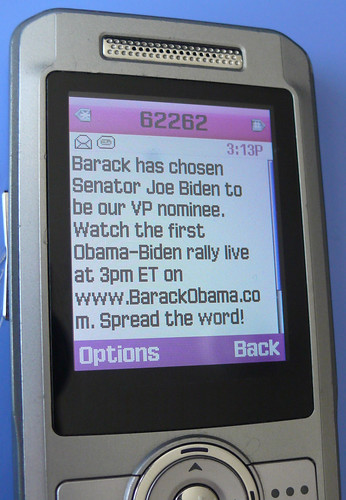
There has been some criticism that it was a sham, that people didn't find out before the media and were disappointed, that it was a waste of time and anticipation. I strongly disagree.
First of all, anybody who thought that a large-scale SMS like this could be pulled off without a hitch is foolish. Different carriers have different delays. I frequently get text messages 4 hours after they are originally sent to me. That's just how it is right now. The Obama text was deployed just after 3am EST, midnight here in San Francisco. I didn't get it until 1:53a my time, just before last call. And not only were the networks flooded with the messages coming out from the Obama campaign, they were flooded with people immediately forwarding the message onto their friends and subsequent SMS exchanges. I sent and received at least 20 text messages within a half hour of receiving my text. I do think it's a bummer that some people never got the SMS but I hardly think that's grounds to call it a scam.
Second, while the New York Times and other major papers put the news online immediately, thus before many people had received their texts, the announcement was absent from some of the print editions of major papers, including the New York Times and the Wall Street Journal. Why? Because the text was sent after most of the Saturday editions had long been put to bed and were peeling off the presses. Sending this kind of information after the major papers have gone to press has traditionally been considered political suicide, but the Obama campaign knew what they were doing. The information was disseminated digitally, not via newsstands. Some critics think the 3am timing was a last dig on Hillary, but I think it was less a dig and more recognizing the importance of that 3am response.
According to some complaints from people who never received the text, I was lucky to get mine at all. But I can honestly say that I've never been so excited to receive a text message. I was nowhere near a computer when the text came, and hadn't received any tips from friends elsewhere in the country, so it was nice to be able to go out, have fun, and receive news like this via 2am SMS. My only real disappointment is that the text didn't start with "Hi, this is Barry!"
It's important to keep in mind that this was an experiment and it was not executed perfectly, but it does serve as a proof of concept. But what other politician has tried something like this on such a large scale? It was a great way for the Obama campaign to harvest phone numbers and build quite a buzz, but it was also a bold use of mobile technology—and great practice for November. As a friend put it, "The blogosphere can't quite yet eclipse the major news media. Heck, twitterverse was convinced it was bloomberg before the runup that day."
Of course, Biden's support of the DMCA and his friendliness with the RIAA are whole different issues...
— Jess Hemerly, August 2008
For some people, the holiday season is the most wonderful time of the year. For me, it's presidential election season. There is no such thing as too much information or oversaturation. Given my obsession, it was only natural for me to sign up for Barack Obama's "First to Know" text message campaign.
I kept my phone out all day Friday anxiously awaiting the text between refreshes of Inkling's Obama-VP prediction markets. (I wasn't the only one.) But by the end of the work day, the text hadn't come, and word from the Internets said that the text would come Saturday.
At 1:53a on Saturday morning as I was putting shoes on and getting ready to leave a friend's house, I got the text:
There has been some criticism that it was a sham, that people didn't find out before the media and were disappointed, that it was a waste of time and anticipation. I strongly disagree.
First of all, anybody who thought that a large-scale SMS like this could be pulled off without a hitch is foolish. Different carriers have different delays. I frequently get text messages 4 hours after they are originally sent to me. That's just how it is right now. The Obama text was deployed just after 3am EST, midnight here in San Francisco. I didn't get it until 1:53a my time, just before last call. And not only were the networks flooded with the messages coming out from the Obama campaign, they were flooded with people immediately forwarding the message onto their friends and subsequent SMS exchanges. I sent and received at least 20 text messages within a half hour of receiving my text. I do think it's a bummer that some people never got the SMS but I hardly think that's grounds to call it a scam.
Second, while the New York Times and other major papers put the news online immediately, thus before many people had received their texts, the announcement was absent from some of the print editions of major papers, including the New York Times and the Wall Street Journal. Why? Because the text was sent after most of the Saturday editions had long been put to bed and were peeling off the presses. Sending this kind of information after the major papers have gone to press has traditionally been considered political suicide, but the Obama campaign knew what they were doing. The information was disseminated digitally, not via newsstands. Some critics think the 3am timing was a last dig on Hillary, but I think it was less a dig and more recognizing the importance of that 3am response.
According to some complaints from people who never received the text, I was lucky to get mine at all. But I can honestly say that I've never been so excited to receive a text message. I was nowhere near a computer when the text came, and hadn't received any tips from friends elsewhere in the country, so it was nice to be able to go out, have fun, and receive news like this via 2am SMS. My only real disappointment is that the text didn't start with "Hi, this is Barry!"
It's important to keep in mind that this was an experiment and it was not executed perfectly, but it does serve as a proof of concept. But what other politician has tried something like this on such a large scale? It was a great way for the Obama campaign to harvest phone numbers and build quite a buzz, but it was also a bold use of mobile technology—and great practice for November. As a friend put it, "The blogosphere can't quite yet eclipse the major news media. Heck, twitterverse was convinced it was bloomberg before the runup that day."
Of course, Biden's support of the DMCA and his friendliness with the RIAA are whole different issues...
— Jess Hemerly, August 2008
Monday, July 7, 2008
Rethinking Free Speech Online [IFTF]
Institute for the Future, July 7, 2008 [Link]
We often think, talk, and write about social networking and public spaces online. But it's easy to forget an important part of the modern-day Internet: private companies rule the Web. Yahoo, Google, Facebook, MySpace are private companies with payrolls, investors, and ultimate ownership over the spaces we use to share and collect information. Are they limiting free speech? Or are we foolish to think of our speech as something that should be "free" in spaces that depend on subscriptions or advertising to stay alive?
Every community and service has its own terms of service, its own set of community guidelines. And for as much as people feel they are being wrongly censored and that their First Amendment rights are violated, community guidelines online are really the equivalent of "No shirt, no shoes, no service": if you don't like these rules, find another place to post.

Photo by jkoshi
For example, at a gathering at a local San Francisco bar a few months ago, I met a Flickr employee whose role is, in part, to field complaints about inappropriate behavior on Flickr. He follows Flickr's set of guidelines in determining what should be made private and what is appropriate for the Flickr public. When it comes to nudity, he must adhere to the "south of the border" rule, where any below-the-belt nudity is stricken from public access. Whether it is art or pornography doesn't matter—Flickr has decided to avoid that debate altogether and draw its own line.
On a much smaller scale, privately hosted community forums frequently develop strict rules of conduct for members and appoint moderators to delete incendiary posts and, in extreme cases, ban frequent offenders from the forum altogether. Even blogs have moderators who remove incendiary comments that they deem irrelevant to the dialog. Banned users frequently complain about their rights to free speech, but in the end, the site's rules reign.
The AP's Anick Jesdanun considers this matter in his July 3rd article, "'Public' online spaces don't carry speech, rights":
The implications become severe when you consider the accusations against Yahoo of working with the Chinese government to identify dissidents using the Internet to speak out against the government. That sort of activity may mar the company's image, but that doesn't undo the fact that users thought they were speaking anonymously in a worldwide forum, beyond the the scrutiny of the Chinese government. These companies know what you are doing online, and the recent Viacom v. YouTube ruling brings into question not only matters of free speech, but also privacy.
Jesdanun's article is an interesting read, and weighs the pros and cons of government intervention in assuring free speech rights online. But until those issues are worked out, as bottom-up as many of these services seem, there is always a ceiling: the company's bottom line.
— Jess Hemerly, July 2007
We often think, talk, and write about social networking and public spaces online. But it's easy to forget an important part of the modern-day Internet: private companies rule the Web.
We often think, talk, and write about social networking and public spaces online. But it's easy to forget an important part of the modern-day Internet: private companies rule the Web. Yahoo, Google, Facebook, MySpace are private companies with payrolls, investors, and ultimate ownership over the spaces we use to share and collect information. Are they limiting free speech? Or are we foolish to think of our speech as something that should be "free" in spaces that depend on subscriptions or advertising to stay alive?
Every community and service has its own terms of service, its own set of community guidelines. And for as much as people feel they are being wrongly censored and that their First Amendment rights are violated, community guidelines online are really the equivalent of "No shirt, no shoes, no service": if you don't like these rules, find another place to post.
Photo by jkoshi
For example, at a gathering at a local San Francisco bar a few months ago, I met a Flickr employee whose role is, in part, to field complaints about inappropriate behavior on Flickr. He follows Flickr's set of guidelines in determining what should be made private and what is appropriate for the Flickr public. When it comes to nudity, he must adhere to the "south of the border" rule, where any below-the-belt nudity is stricken from public access. Whether it is art or pornography doesn't matter—Flickr has decided to avoid that debate altogether and draw its own line.
On a much smaller scale, privately hosted community forums frequently develop strict rules of conduct for members and appoint moderators to delete incendiary posts and, in extreme cases, ban frequent offenders from the forum altogether. Even blogs have moderators who remove incendiary comments that they deem irrelevant to the dialog. Banned users frequently complain about their rights to free speech, but in the end, the site's rules reign.
The AP's Anick Jesdanun considers this matter in his July 3rd article, "'Public' online spaces don't carry speech, rights":
While mindful of free speech and other rights, Yahoo and other companies say they must craft and enforce guidelines that go beyond legal requirements to protect their brands and foster safe, enjoyable communities — ones where minors may be roaming.
Guidelines help "engender a positive community experience," one to which users will want to return, said Anne Toth, Yahoo's vice president for policy.
[...]
Heather Champ, community director for Flickr, said the company crafts policies based on feedback from users and trains employees to weigh disputes fairly and consistently, though mistakes can happen.
"We're humans," she said. "We're pretty transparent when we make mistakes. We have a record of being good about stepping up and fessing up."
But that underscores another consequence of having online commons controlled by private corporations. Rules aren't always clear, enforcement is inconsistent, and users can find content removed or accounts terminated without a hearing. Appeals are solely at the service provider's discretion.
The implications become severe when you consider the accusations against Yahoo of working with the Chinese government to identify dissidents using the Internet to speak out against the government. That sort of activity may mar the company's image, but that doesn't undo the fact that users thought they were speaking anonymously in a worldwide forum, beyond the the scrutiny of the Chinese government. These companies know what you are doing online, and the recent Viacom v. YouTube ruling brings into question not only matters of free speech, but also privacy.
Jesdanun's article is an interesting read, and weighs the pros and cons of government intervention in assuring free speech rights online. But until those issues are worked out, as bottom-up as many of these services seem, there is always a ceiling: the company's bottom line.
— Jess Hemerly, July 2007
Thursday, April 3, 2008
Songbird: Future of the Free Media Web [IFTF]
Institute for the Future, April 4, 2008 [Link]
Two things we are beginning to talk about regularly at IFTF are open source and free media. Songbird, a media player in development by San Francisco's Pioneers of the Inevitable, harnesses both of these things. Songbird recently released its 0.5 version, and while not quite ready for consumers yet, it is building a strong community of developers and users.
From their website:
Built on Mozilla's XUL, Songbird is both a media player and web browser. By mashing up these applications, Songbird features a few interesting innovations. When surfing to an MP3 blog page, Songbird automatically sniffs out any media on the page and pops up a playlist of those tracks. Instead of having to download or play in a separate tab to test out the track, users can double click the song in the pop-up playlist to sample it. If you like it, you can simply click "Download" to save the song to your library. Once in your library, you can drag the track to a playlist or transfer it to a portable device. Songbird also lets you view your library in tag clouds and filter your library by metadata categories iTunes doesn't support.

Since it's open source, Songbird leverages an add-on platform for developers to create their own extensions and themes called "Feathers." There are already a good number of add-ons for Songbird, including a few that contextualize your music listening with metadata from all over the Web. My favorite thus far is an eMusic plugin that allows you to surf and download from eMusic directly through the player, bypassing eMusic's downloader, making the overall user experience much friendlier for eMusic users. Developers have also created device support for nearly every portable music device under the sun, including the iPod.

For audiophiles who scour the Internet for free media, Songbird is a great all-inclusive tool—a window to an Internet teeming with free media. The Internet provides the content, but Songbird helps your harvest, use, and make sense of it. As the community grows, it will be interesting to see what extensions people create and what kind of user base Songbird will foster. This recent release has brought them some good press, including MacLife and Wired. For more detailed information, check out the Songbird blog.
— Jess Hemerly,
Two things we are beginning to talk about regularly at IFTF are open source and free media. Songbird, a media player in development by San Francisco's Pioneers of the Inevitable, harnesses both of these things.
Two things we are beginning to talk about regularly at IFTF are open source and free media. Songbird, a media player in development by San Francisco's Pioneers of the Inevitable, harnesses both of these things. Songbird recently released its 0.5 version, and while not quite ready for consumers yet, it is building a strong community of developers and users.
From their website:
Play music. Play the Web.
Songbird is a desktop media player mashed-up with the Web. Songbird is committed to playing the music you want, from the sites you want, on the devices you want, challenging the conventions of discovery, purchase, consumption and organization of music on the Internet.
Songbird is a player and a platform. Like Firefox, Songbird is an open source, Open Web project built on the Mozilla platform. Songbird provides a public playground for Web media mash-ups by providing developers with both desktop and Web APIs, developer resources and fostering Open Web media standards, to wit, an Open Media Web.
Built on Mozilla's XUL, Songbird is both a media player and web browser. By mashing up these applications, Songbird features a few interesting innovations. When surfing to an MP3 blog page, Songbird automatically sniffs out any media on the page and pops up a playlist of those tracks. Instead of having to download or play in a separate tab to test out the track, users can double click the song in the pop-up playlist to sample it. If you like it, you can simply click "Download" to save the song to your library. Once in your library, you can drag the track to a playlist or transfer it to a portable device. Songbird also lets you view your library in tag clouds and filter your library by metadata categories iTunes doesn't support.
Since it's open source, Songbird leverages an add-on platform for developers to create their own extensions and themes called "Feathers." There are already a good number of add-ons for Songbird, including a few that contextualize your music listening with metadata from all over the Web. My favorite thus far is an eMusic plugin that allows you to surf and download from eMusic directly through the player, bypassing eMusic's downloader, making the overall user experience much friendlier for eMusic users. Developers have also created device support for nearly every portable music device under the sun, including the iPod.
For audiophiles who scour the Internet for free media, Songbird is a great all-inclusive tool—a window to an Internet teeming with free media. The Internet provides the content, but Songbird helps your harvest, use, and make sense of it. As the community grows, it will be interesting to see what extensions people create and what kind of user base Songbird will foster. This recent release has brought them some good press, including MacLife and Wired. For more detailed information, check out the Songbird blog.
— Jess Hemerly,
Sunday, September 23, 2007
IDFTF: Institute for Doing the Future [IFTF]
Institute for the Future, September 23, 2007 [Link]
David Pescovitz, Mike Love and I joined Bob Johansen at SQUID Labs today, where Bob talked about IFTF, our foresight/insight/action mantra, and his book, Get There Early. SQUID Labs is a unique breeding ground for innovation with a social bent. From their website:
While we at IFTF spend most of our time thinking about the future, the guys over at SQUID Labs are doing the future. IFTF is about foresight; SQUID Labs is about action. As one of the SQUID guys said today, you might think of them as the Institute for Doing the Future.
A great example of something to come out of their work is a SQUID spinoff company, Potenco. SQUID Labs co-founder Colin Bulthaup is the company's CEO. Their product is a pull-cord generator, intended for use with the XO Laptop (One Laptop Per Child Project). Check out their website for the specs. It's a great solution to the problem of providing electricity to places that lack an energy infrastructure.
One of the most interesting things that came out of today was an understanding of how the two organizations could really work together. We would be able to provide an idea of what areas or technology or engineering will present problems or dilemmas potentially needing solutions, and the SQUID Labs team could take cues from our forecasts to start working on these solutions before the problems really become problems.
They also happen to have a very cool location, in the control tower on the Alameda Naval Air Station.
— Jess Hemerly, September 2007
David Pescovitz, Mike Love and I joined Bob Johansen at SQUID Labs today, where Bob talked about IFTF, our foresight/insight/action mantra, and his book, Get There Early. SQUID Labs is a unique breeding ground for innovation with a social bent.
David Pescovitz, Mike Love and I joined Bob Johansen at SQUID Labs today, where Bob talked about IFTF, our foresight/insight/action mantra, and his book, Get There Early. SQUID Labs is a unique breeding ground for innovation with a social bent. From their website:
At SQUID Labs we develop breakthrough technologies and find solutions to unique engineering problems. Our exceptional team has expertise in a wide range of technical fields: from chip design and electronics to robotics, materials, embedded systems and manufacturing. We have created a highly dynamic and creative work environment which helps to inspire our consulting and contract research efforts.
In the course of our work (and play) we have developed novel and diverse technologies for a wide range of applications including printed electronics, lens molding, and high performance kites.
SQUID Labs is characterized by our multidisciplinary skill set and our ability to combine those diverse skills to create novel solutions.
"We're not a think tank, we're a do tank"
While we at IFTF spend most of our time thinking about the future, the guys over at SQUID Labs are doing the future. IFTF is about foresight; SQUID Labs is about action. As one of the SQUID guys said today, you might think of them as the Institute for Doing the Future.
A great example of something to come out of their work is a SQUID spinoff company, Potenco. SQUID Labs co-founder Colin Bulthaup is the company's CEO. Their product is a pull-cord generator, intended for use with the XO Laptop (One Laptop Per Child Project). Check out their website for the specs. It's a great solution to the problem of providing electricity to places that lack an energy infrastructure.
One of the most interesting things that came out of today was an understanding of how the two organizations could really work together. We would be able to provide an idea of what areas or technology or engineering will present problems or dilemmas potentially needing solutions, and the SQUID Labs team could take cues from our forecasts to start working on these solutions before the problems really become problems.
They also happen to have a very cool location, in the control tower on the Alameda Naval Air Station.
— Jess Hemerly, September 2007
Subscribe to:
Posts (Atom)